menu_book
Before / After Novel Adaptation
3636 words → 171 manga panels
description
Original Novel Prose (Source Manuscript)
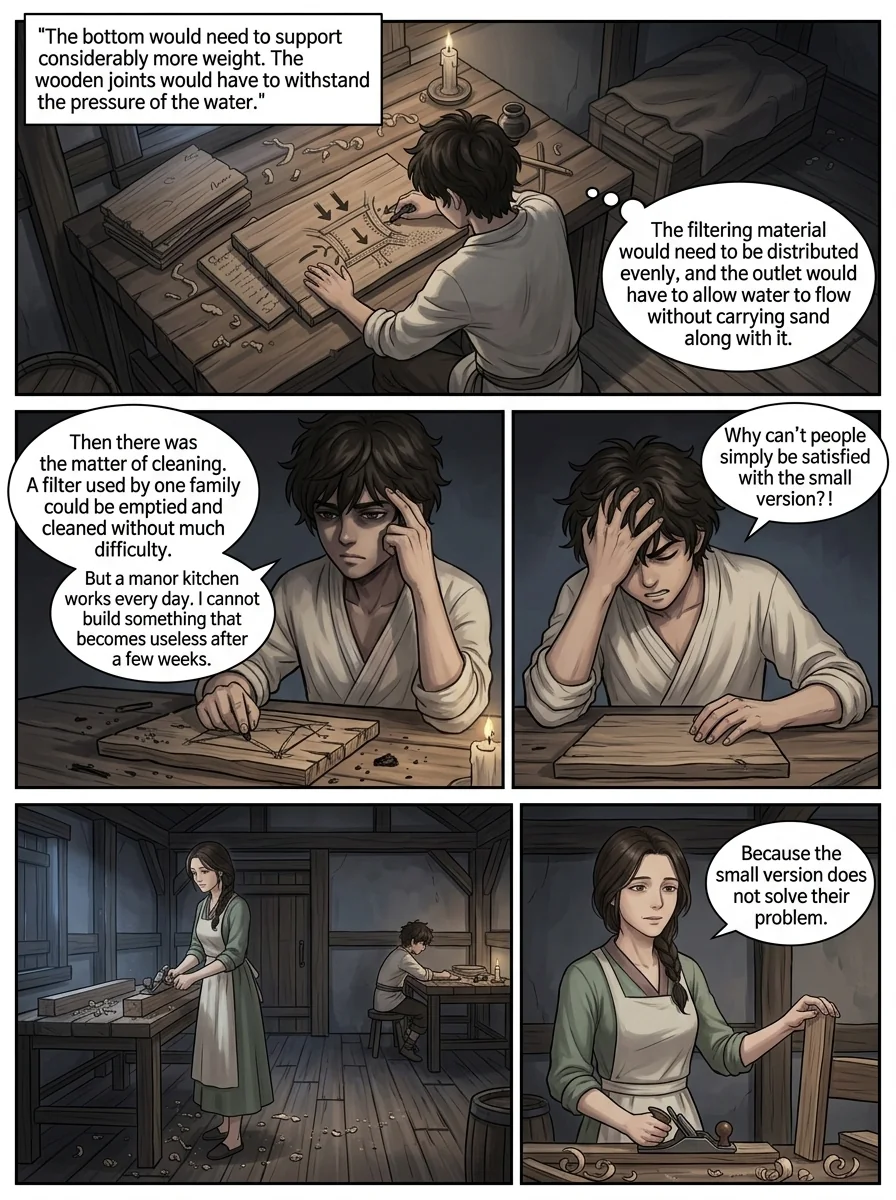
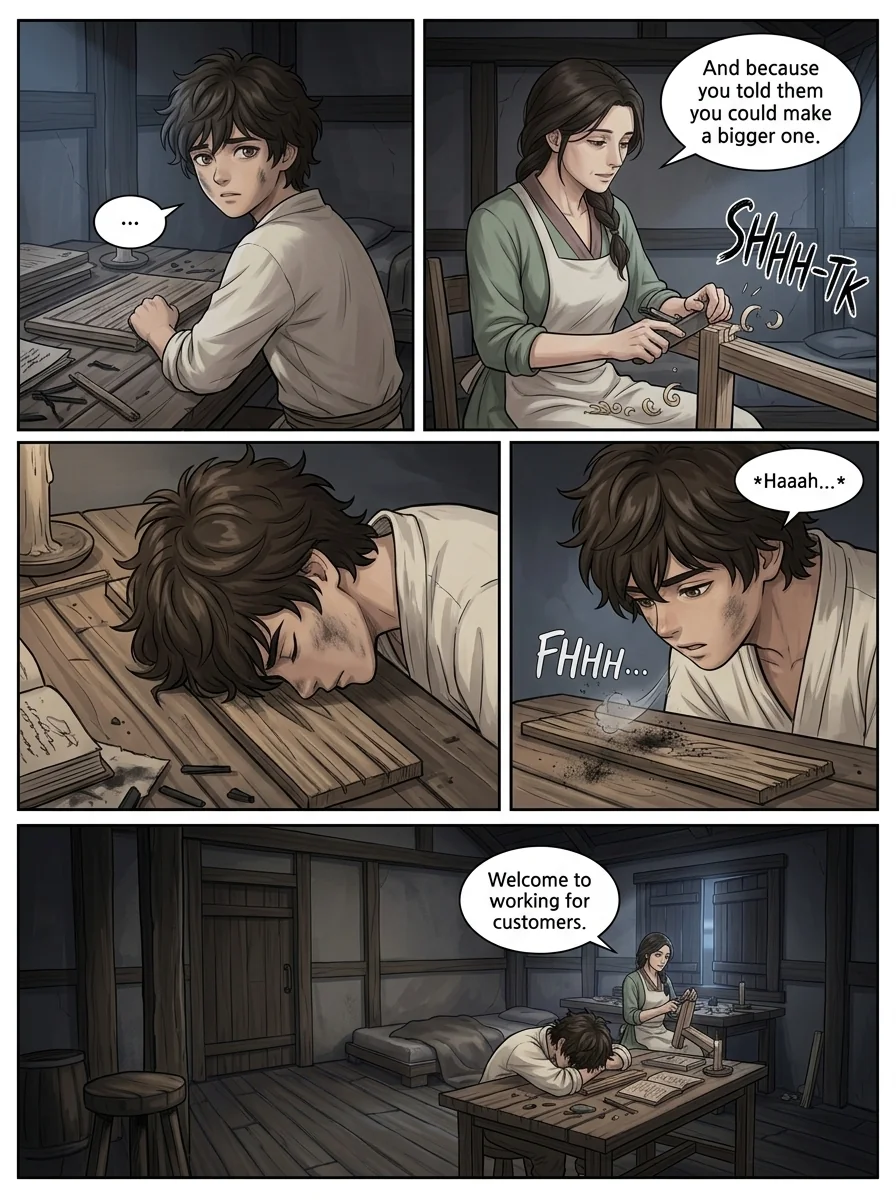
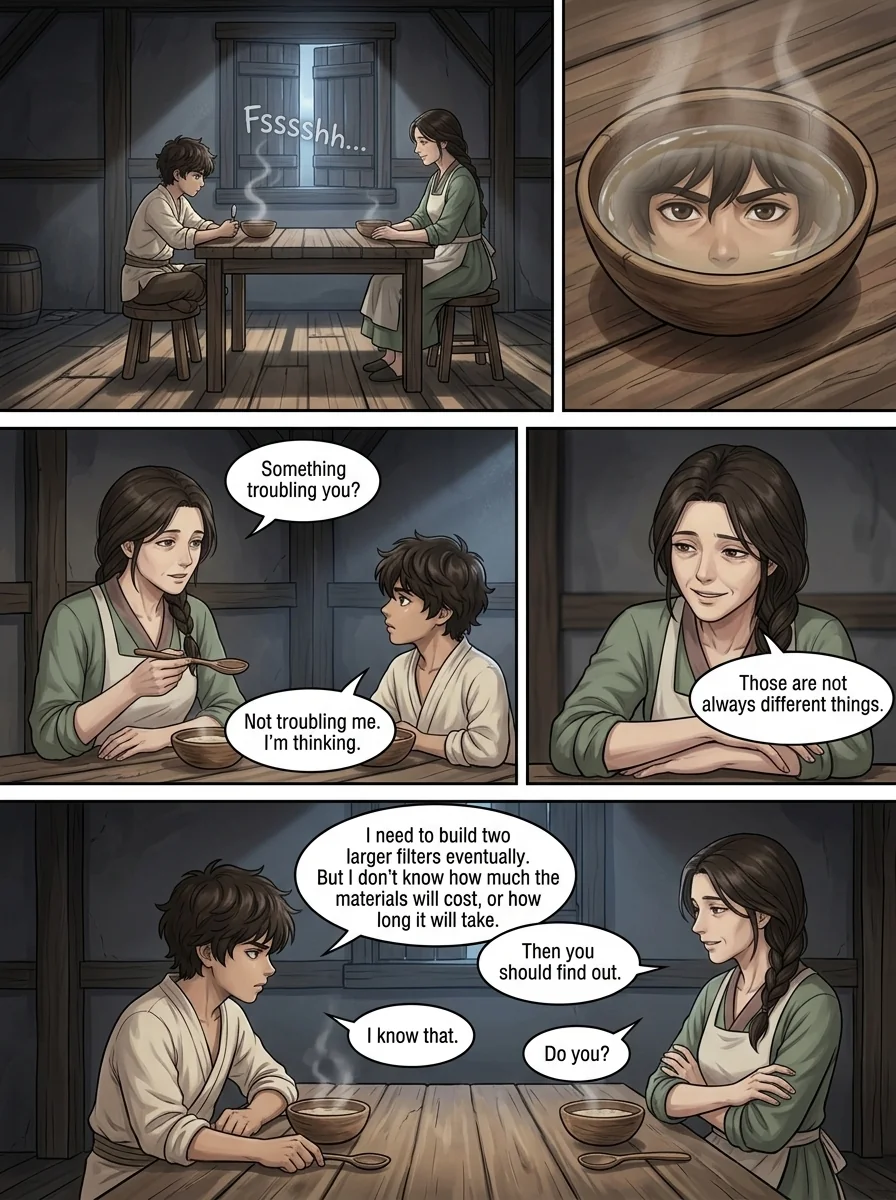
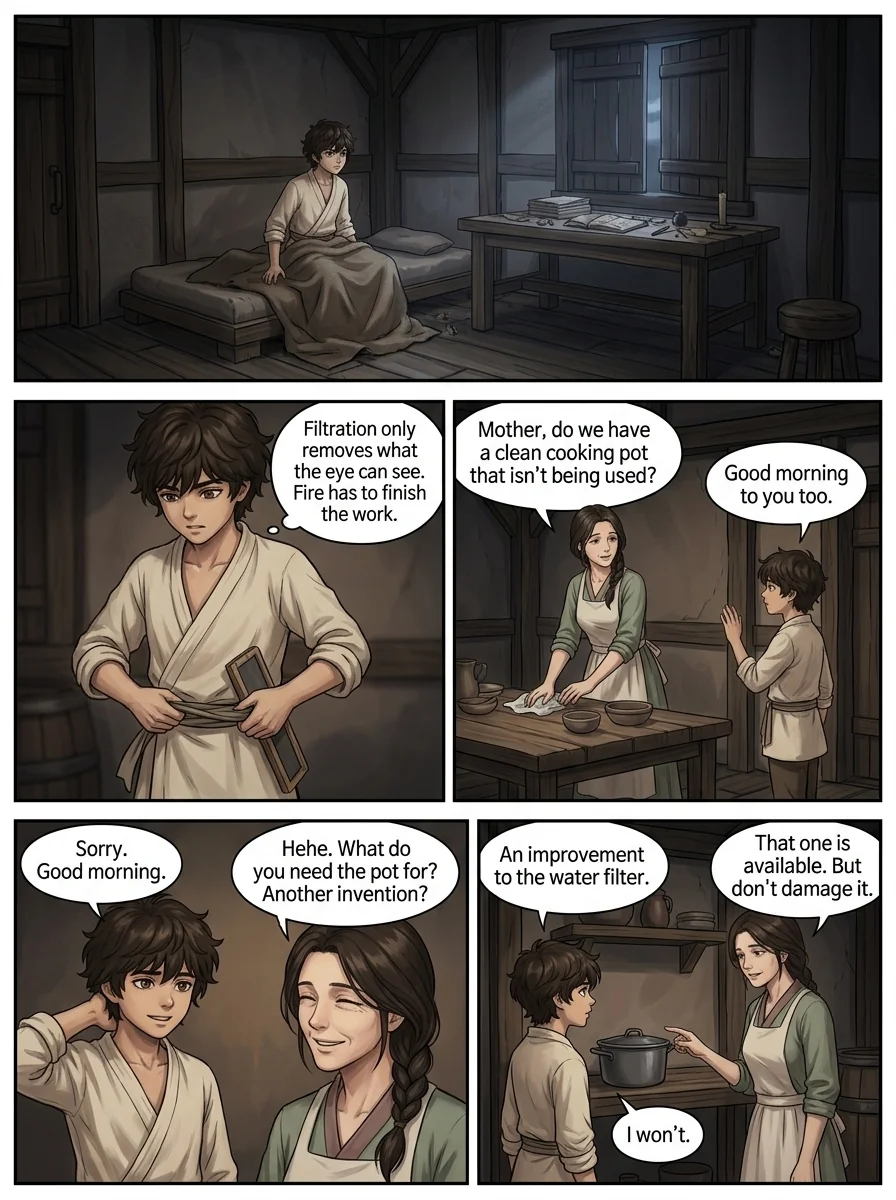
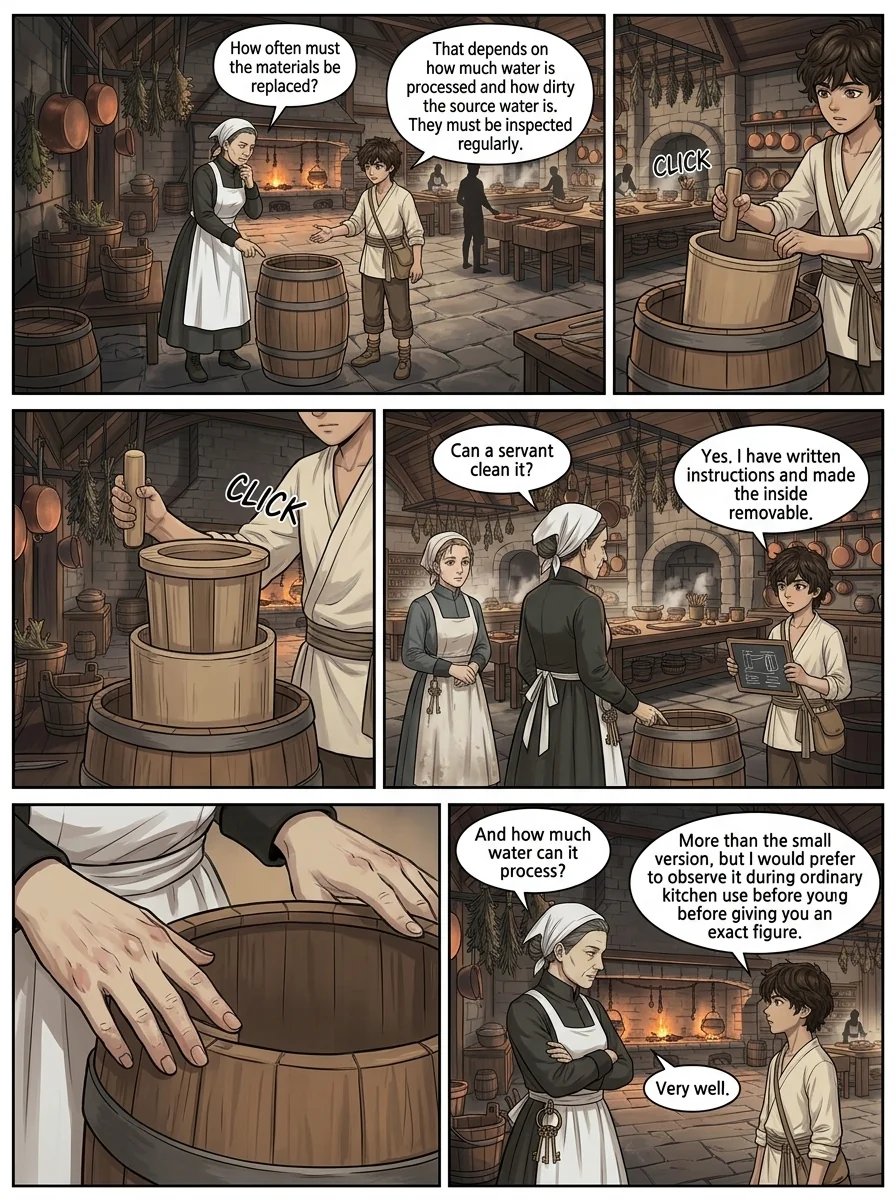
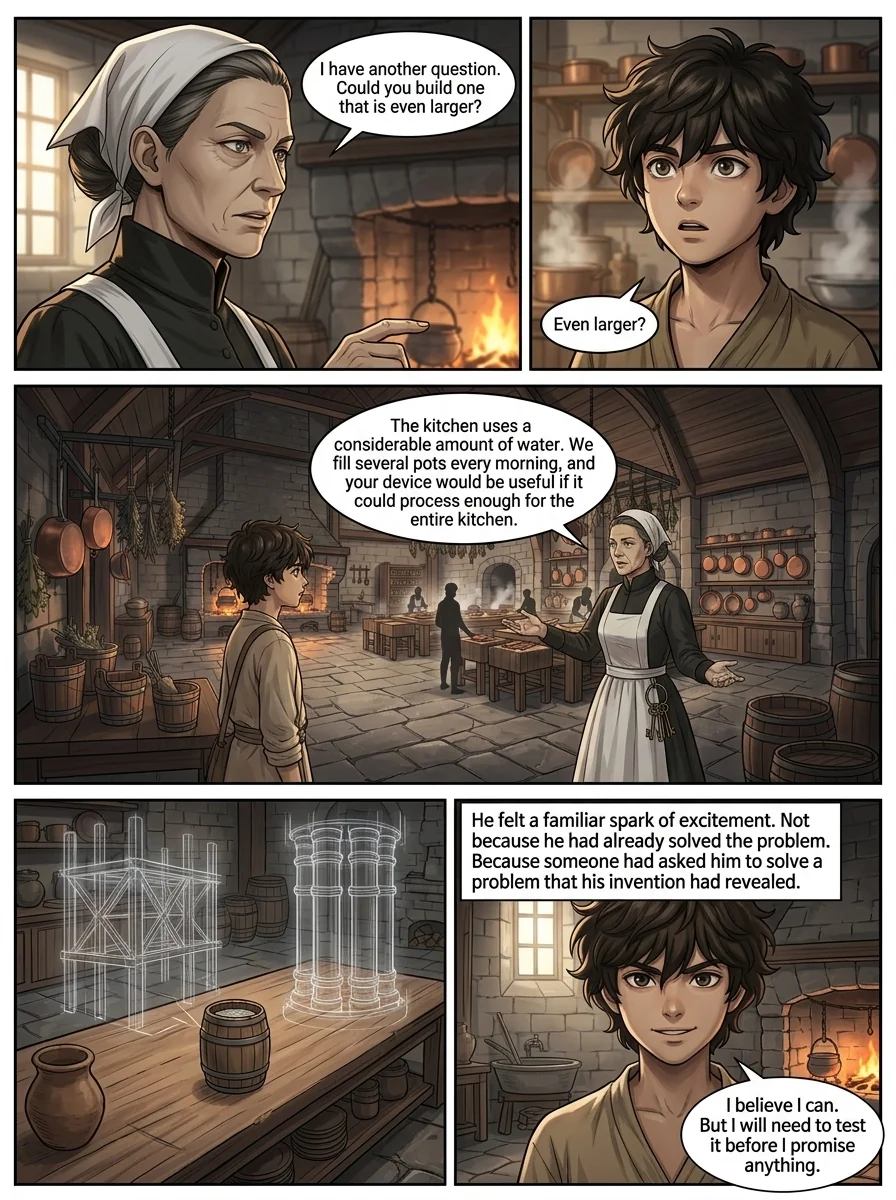
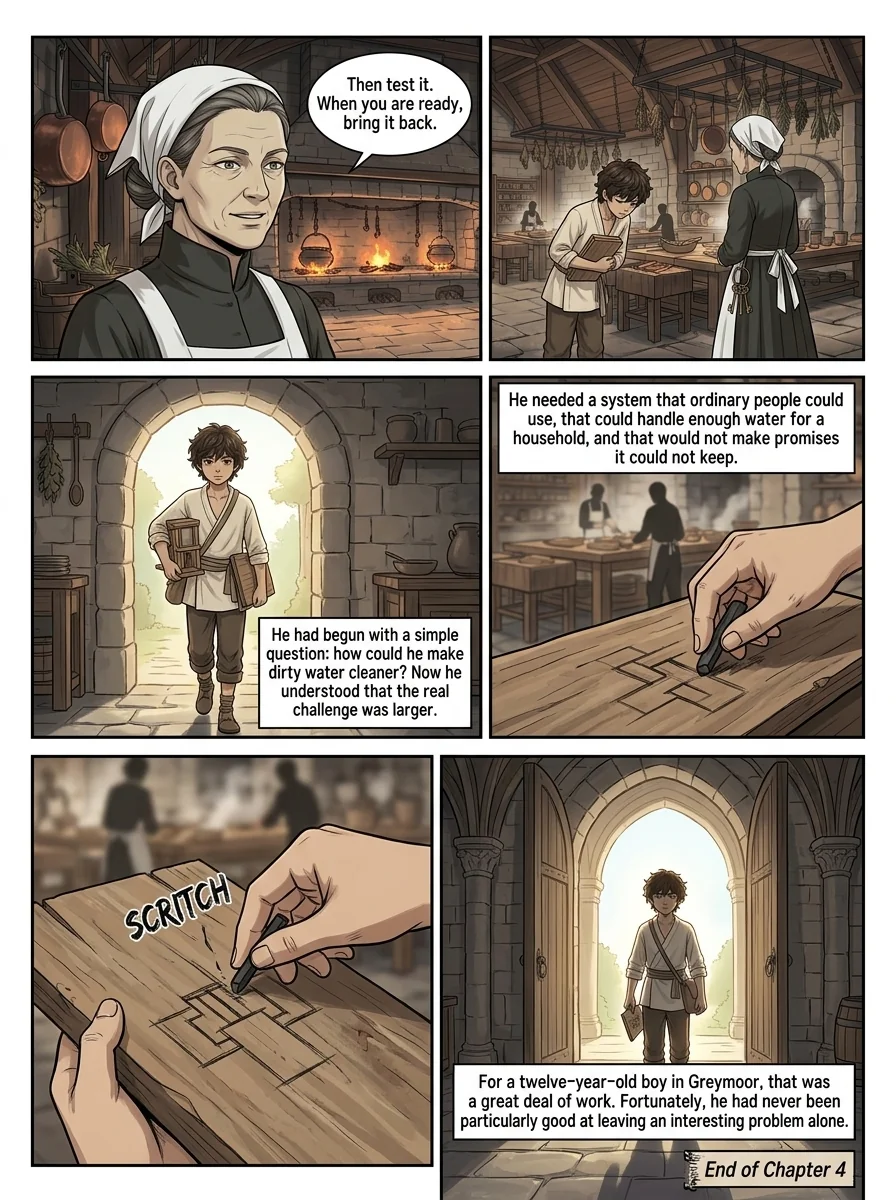
# Chapter 4 — A Bigger Problem · The moment he returned home from the manor, the boy began thinking about the housekeeper's request. · A larger filter. · At first, it sounded like a simple task. If a small filter could handle a bucket of water, surely a larger one could handle several buckets. · Unfortunately, making something bigger was rarely as simple as making more of the same thing. · He discovered this before he had even finished his first sketch. · His original filter consisted of a sturdy wooden frame, a container filled with layers of gravel, sand, and charcoal, and an outlet through which the filtered water could flow into a clean vessel. · It worked well enough for small quantities. · But if he increased the size of the container without changing anything else, several problems appeared. · The bottom would need to support considerably more weight. The wooden joints would have to withstand the pressure of the water. The filtering material would need to be distributed evenly, and the outlet would have to allow water to flow without carrying sand along with it. · Then there was the matter of cleaning. · A filter used by one family could be emptied and cleaned without much difficulty. A device used in a manor kitchen would be expected to work every day. · He could not build something that became useless after a few weeks. · He sat at his wooden table, rubbing his forehead. · "Why can't people simply be satisfied with the small version?" · His father, who was working on a chair near the window, looked up. · "Because the small version does not solve their problem." · The boy glanced at him. · His father returned to his work. · "And because you told them you could make a bigger one." · The boy sighed. · His father smiled faintly. · "Welcome to working for customers." · ## The Cost of Making Things · The next morning, the boy woke earlier than usual. · He ate breakfast with his parents, although his attention was clearly elsewhere. His mother noticed him staring at the wooden bowl in front of him rather than eating. · "Something troubling you?" · "Not troubling me. I'm thinking." · "Those are not always different things," his father remarked. · The boy ignored him. · "I need to build two larger filters eventually. But I don't know how much the materials will cost, or how long it will take." · His father put down his spoon. · "Then you should find out." · "I know that." · "Do you?" · The boy looked at him. · His father reached for a small wooden board and a piece of charcoal. · "Tell me what you need." · The boy began listing the materials. · "A barrel, some wood for the stand, a removable support, gravel, sand, charcoal, and something to keep the outlet from getting blocked." · "Good. What else?" · He thought for a moment. · "Tools." · "Those belong to the workshop. But if you damage one, who pays for it?" · "I do." · "Correct. What else?" · The boy frowned. · "Transport?" · "Yes." · "Time?" · His father nodded. · "Your time has value too. If you spend three days making something that earns you ten copper coins, you might have been better off helping me in the workshop." · The boy looked down at the board. · He had never properly considered that. · In his previous life, he remembered learning about production costs, wages, and profit. But those concepts had seemed distant and abstract. Here, every copper coin mattered. · His father continued. · "A merchant who forgets the cost of his own work eventually discovers that he has been working for free." · His mother chuckled. · "Your father learned that lesson the difficult way." · "That was different," his father protested. · "Of course it was." · The boy smiled. · For once, he was grateful that his parents were willing to teach him these things. They could not provide him with much money, but they could give him something that might prove just as valuable. · Experience. · After breakfast, he gathered his notes and headed toward his father's workshop. · ## The Carpenter's Advice · The workshop smelled of fresh wood and old sawdust. · His father was working on a chair for a merchant who lived near the village square. Several boards had already been cut, and the pieces were arranged neatly beside the workbench. · The boy placed his drawings on an empty section of the table. · "I need your opinion." · His father wiped his hands and examined them. · The drawings showed a large wooden container with several layers inside. Beneath it was a stand, and at the bottom was a small outlet. · His father studied the design. · "You want to build the container yourself?" · "I thought about it." · "Why?" · "Because it would fit the filter better." · "That is one reason. Is it a good reason?" · The boy hesitated. · His father tapped the drawing. · "You could spend several days making a container from separate wooden boards. You would need to make the joints tight enough to hold water, and even then there might be leaks." · He pointed toward the back of the workshop. · "Or you could buy a barrel from the cooper." · The boy followed his finger. · A barrel. · Of course. · He had been so focused on inventing something that he had forgotten he did not need to invent every part of it. · "I could modify an existing barrel." · "Exactly." · His father returned to the chair. · "An inventor does not need to make every piece himself. He needs to understand what each piece must accomplish." · The boy wrote that sentence down. · Then he looked at the drawing again. · "What about the stand?" · "That I can help you with. But you will have to pay for the wood." · "Even though I'm your son?" · His father gave him a serious look. · "Especially because you are my son. I want you to understand what it costs to make things." · The boy laughed. · "You're enjoying this." · "A little." · His father picked up a piece of wood and examined it. · "Come back this afternoon. I'll show you how to calculate the weight the stand needs to support." · That was another thing the boy appreciated about his father. · He never simply gave him an answer when he could teach him how to find one. · ## A Visit to the Cooper · The village cooper's workshop stood near the road leading toward the market. · Barrels of different sizes occupied most of the space. Some were freshly assembled, their wooden staves held together by iron hoops. Others had been repaired so many times that their surfaces were dark with age. · The cooper himself was a broad-shouldered man named Harlan. · He looked up when the boy entered. · "Well, if it isn't the young inventor." · The boy smiled politely. · "Good morning, Master Harlan." · "What brings you here? Another strange request?" · "I need a barrel." · Harlan raised an eyebrow. · "That's a surprisingly ordinary request." · "For an unusual purpose." · The cooper laughed. · "Of course it is." · The boy explained the filter and showed him his drawings. · Harlan listened carefully, occasionally interrupting with questions. · "You want water to pass through the barrel?" · "Yes." · "And you want the materials inside to remain in place?" · "Exactly." · "And how do you intend to prevent the sand from escaping through the outlet?" · The boy hesitated. · "I am still working on that." · Harlan folded his arms. · "Then you have found your first problem." · "I know." · "Good. Some people become angry when their ideas are questioned." · The cooper walked toward the back of his workshop and returned with three barrels. · The first was small and narrow, originally intended for transporting wine. · The second was wider, with a thick wooden base. · The third was an old water barrel that had been repaired several times. · The boy inspected each one. · The smallest was too narrow. The old barrel was too damaged. · The second seemed suitable. · "How much for this one?" · Harlan named a price. · The boy frowned. · "That's more than I expected." · "Then perhaps you expected too little." · The boy sighed. · "Could I buy a barrel with a small defect? It doesn't need to be pretty, only strong enough to hold water." · Harlan considered that. · After searching through his workshop, he found a barrel with a damaged outer hoop. The wood itself was still sound. · It was not particularly attractive, but it would serve. · They agreed on a lower price. · Before leaving, the boy asked whether Harlan could make a removable wooden support for the inside. · "What sort of support?" · He explained the design. · Harlan examined the drawing and nodded slowly. · "I can make that. But I'll charge you for the work." · "Of course." · "And if your invention succeeds, you'll remember where you bought your barrel." · The boy smiled. · "If it succeeds, I'll probably need another." · That earned him a proper laugh. · ## The First Large Prototype · The barrel arrived at his father's workshop two days later. · The boy had already prepared most of the other materials. · He had collected gravel from a nearby stream, washed it repeatedly, and separated it by size. The sand had been washed until the water running through it was no longer visibly muddy. The charcoal had been broken into smaller pieces and rinsed to remove loose dust. · He knew that cleanliness mattered. · There was little point in constructing a filter only to fill it with dirty materials. · His father helped him build a sturdy stand. · The boy wanted the barrel to sit high enough for the water to flow into a collection vessel beneath it. The stand also needed to remain stable when the barrel was full. · His father insisted on testing the joints before allowing him to use it. · "Better to discover a weak joint now than when someone is standing beside it," he explained. · Together, they checked the supports and reinforced one corner. · Once the stand was finished, the boy carried the barrel to his little workshop in the woods. · He placed the internal support inside and began arranging the filtering materials. · The gravel went in first, followed by the sand and prepared charcoal, with the layers arranged according to his latest design. · He worked slowly. · Each layer had to be distributed evenly. · When he finished, he stepped back and admired his work. · It looked impressive. · It was also considerably heavier than his first filter. · He placed a collection vessel underneath and poured in the first bucket of water. · Nothing happened. · He waited. · A few drops emerged from the outlet. · He waited longer. · Another few drops followed. · The boy stared at the barrel. · "You're joking." · The barrel remained silent. · He checked the outlet. It was not blocked. He examined the layers, looking for an obvious mistake. · The problem was the filtering material. He had packed too much fine sand into the barrel, and the water was passing through it painfully slowly. · His first instinct was to remove some of the sand. · Instead, he stopped and thought. · The manor did not merely need cleaner-looking water. It needed enough filtered water to make the device useful. · A filter that produced a cup every few minutes would be little better than his original small version. · He emptied the barrel and began again. · This time, he adjusted the arrangement and paid greater attention to how evenly the materials were distributed. · The second attempt flowed more freely. · Unfortunately, the water that emerged carried fine particles of sand. · The boy closed the outlet and groaned. · One problem solved. Another created. · He spent the afternoon testing different arrangements, recording how quickly water passed through and how much visible material escaped. · By evening, he had learned something important. · A filter was not simply a container filled with useful materials. · The structure holding those materials mattered just as much. · ## A Lesson from the Past · That night, the boy lay in bed thinking about the failed experiments. · He had made progress, but not enough. · His little filter had been useful for improving the appearance of water. The larger version could process more, but it still had weaknesses. · And even if he perfected the physical construction, the problem of drinking water remained. · He closed his eyes. · His thoughts drifted toward memories of his previous life. · He remembered school lessons, public information posters, and the familiar sight of water being boiled in kitchens. · He remembered something about microorganisms. · Something about temperature. · Something about how long water needed to be heated. · But the details were scattered. · He knew that boiling water could make it safer to drink, but he wanted to remember the proper method. He also remembered that water could become contaminated again after treatment if it was handled carelessly. · He turned over. · Tomorrow, he would have to think about it again. · Eventually, exhaustion overcame him. · And then he dreamed. · He was standing in a place that did not belong to Greymoor. · White walls surrounded him. Metal pipes ran along the ceiling. A large glass vessel stood on a table, and water moved through a series of containers connected by narrow tubes. · He could not read the labels. · Yet the purpose of the equipment seemed strangely familiar. · The scene changed. · He saw water being poured through a filter. Dirt and particles remained behind while clearer water flowed into another container. · Then he saw a pot being placed over a fire. · A familiar voice spoke. · "Filtering and disinfecting are not the same thing." · The boy watched the water heat. · The memory became clearer. · Boiling water was a simple and effective way to kill many disease-causing organisms. It did not matter whether the water looked dirty or clear. What mattered was that the water reached the proper temperature and was kept at a rolling boil for the recommended period. · Another image appeared. · A clean container with a lid. · A ladle resting beside it. · The voice continued. · "Clean water can become contaminated again." · The boy watched someone pour the boiled water into the covered container. · Then the scene faded. · He awoke suddenly. · For several seconds, he did not move. · The room was dark. His blanket had slipped to the floor, and the cold air made him shiver. · Then he sat upright. · "Of course." · He had been trying to make one device accomplish everything. · But the simplest solution was not necessarily a more complicated filter. · It was a reliable process. · First, remove as much dirt as possible. · Then treat the water properly. · Finally, protect it from becoming contaminated again. · He had remembered the missing piece. · Not a magical substance. · Not a miraculous filter. · Simply the knowledge that he had once taken for granted. · ## The Complete Method · The following morning, the boy was out of bed before sunrise. · He went to the kitchen and found his mother preparing breakfast. · "Mother, do we have a clean cooking pot that isn't being used?" · She looked at him. · "Good morning to you too." · "Sorry. Good morning." · She laughed. · "What do you need the pot for?" · "I want to test something." · His mother studied his expression. · "Another invention?" · "An improvement to the water filter." · She pointed toward a spare pot near the wall. · "That one is available. But don't damage it." · "I won't." · He took the pot and carried it to his workshop. · His plan was straightforward. · He would filter the water first, then boil it separately. Once it had been treated, he would allow it to cool in a clean, covered vessel. · He knew that boiling needed to be done properly. His memory suggested a rolling boil for at least one minute, with a longer period at higher elevations. Greymoor was not particularly high, but he intended to follow the safest practical guidance he remembered. · He filtered a batch of water. · Then he poured it into the cooking pot and placed it over a fire. · He watched carefully as the water heated. · When it reached a rolling boil, he maintained it for the required time. · Afterward, he removed the pot from the fire and covered it with a clean lid. · He did not drink it immediately. · Instead, he repeated the process and checked his notes. · He also began thinking about how to explain the method to someone who had never heard of invisible organisms. · He could not simply tell people that the water contained tiny creatures. · Most would probably laugh. · Instead, he would explain that water could carry sickness even when it looked clean, and that boiling was necessary to make it safer for drinking. · His mother came to inspect his work later that morning. · "So your wooden device removes the dirt," she said, "but the fire makes the water safe?" · "That is the idea." · "And if someone uses the filter but skips the boiling?" · "Then I cannot promise the water is safe." · His mother nodded. · "Good. Never promise what you cannot guarantee." · He wrote those words into his notes. · ## Testing the Routine · Over the following days, the boy worked on making the process practical. · He improved the filter so that it could produce clearer water more consistently. He also designed a separate collection vessel that could be covered after the water had been boiled and cooled. · The problem was not simply making the device work once. · It had to work every day. · He tested different quantities of water, recorded how long filtration took, and checked how often the filtering materials needed attention. · He also learned that the charcoal could become clogged and that the sand and gravel needed regular cleaning or replacement. · His first large prototype was far from perfect. · But each experiment taught him something. · One afternoon, his father found him examining the wooden support. · "What are you looking for?" · "A weakness." · His father leaned closer. · "Have you found one?" · "Not yet." · "Then perhaps you should look for one before it finds you." · The boy laughed. · His father examined the construction. · "That is a heavy barrel. Are you certain the stand can support it?" · "I tested it." · "With water?" · "Yes." · "How much?" · The boy hesitated. · His father raised an eyebrow. · "Exactly." · They tested it again, gradually increasing the weight. · One of the joints began to shift. · His father pointed at it. · "There." · The boy stared at the joint. · He had been so focused on the filter itself that he had nearly overlooked the stand. · They reinforced it together. · This time, the structure remained stable. · The boy added another note to his records. · **Test the entire invention, not only the part that seems important.** · ## The Housekeeper's Request · When he next visited his mother at the manor, he brought the improved filter with him. · The head housekeeper was waiting in the kitchen when he arrived. · "You have returned," she said. · "Yes, ma'am. I have made some improvements." · "Have you solved the problem?" · "I believe I have a reliable method now. The filter removes much of the visible dirt and improves the water's clarity. Afterward, the water must be properly boiled and stored in a clean, covered container." · The housekeeper studied him. · "So the filter alone does not make the water safe?" · "No, ma'am. I would rather tell you that now than have someone misunderstand what it can do." · For a moment, she said nothing. · Then she gave a small, approving nod. · "That is a sensible answer. A dishonest merchant would have told me his invention could do everything." · The boy resisted the urge to smile. · He was twelve, not a merchant, and he was beginning to understand that the difference between a clever invention and a trustworthy business might be honesty. · He demonstrated the improved filter. · The servants watched as the water passed through the layers and collected in the vessel below. The difference in clarity was obvious. · Then he explained the boiling process and the importance of keeping the treated water covered. · The housekeeper listened carefully. · When he finished, she asked several questions. · "How often must the materials be replaced?" · "That depends on how much water is processed and how dirty the source water is. They must be inspected regularly." · "Can a servant clean it?" · "Yes. I have written instructions and made the inside removable." · "And how much water can it process?" · The boy considered his answer. · "More than the small version, but I would prefer to observe it during ordinary kitchen use before giving you an exact figure." · The housekeeper nodded. · "Very well." · She looked at the barrel again. · "I have another question. Could you build one that is even larger?" · The boy blinked. · "Even larger?" · "The kitchen uses a considerable amount of water. We fill several pots every morning, and your device would be useful if it could process enough for the entire kitchen." · He looked at his invention. · He had spent so much time perfecting the process that he had barely considered how it would work on a larger scale. · A larger filter would need stronger supports, more filtering material, and a way to prevent the weight of the water from damaging the structure. · It would also need to be easy to clean and maintain. · And the larger quantity of water would still need proper treatment afterward. · He felt a familiar spark of excitement. · Not because he had already solved the problem. · Because someone had asked him to solve a problem that his invention had revealed. · "I believe I can," he said carefully. "But I will need to test it before I promise anything." · The head housekeeper smiled. · "Then test it. When you are ready, bring it back." · The boy left the manor with his small filter under one arm and a new challenge occupying his thoughts. · He had begun with a simple question: how could he make dirty water cleaner? · Now he understood that the real challenge was larger. · He needed a system that ordinary people could use, that could handle enough water for a household, and that would not make promises it could not keep. · For a twelve-year-old boy in Greymoor, that was a great deal of work. · Fortunately, he had never been particularly good at leaving an interesting problem alone. · **End of Chapter 4**
# Chapter 4 — A Bigger Problem
The moment he returned home from the manor, the boy began thinking about the housekeeper's request.
A larger filter.
At first, it sounded like a simple task. If a small filter could handle a bucket of water, surely a larger one could handle several buckets.
Unfortunately, making something bigger was rarely as simple as making more of the same thing.
He discovered this before he had even finished his first sketch.
His original filter consisted of a sturdy wooden frame, a container filled with layers of gravel, sand, and charcoal, and an outlet through which the filtered water could flow into a clean vessel.
It worked well enough for small quantities.
But if he increased the size of the container without changing anything else, several problems appeared.
The bottom would need to support considerably more weight. The wooden joints would have to withstand the pressure of the water. The filtering material would need to be distributed evenly, and the outlet would have to allow water to flow without carrying sand along with it.
Then there was the matter of cleaning.
A filter used by one family could be emptied and cleaned without much difficulty. A device used in a manor kitchen would be expected to work every day.
He could not build something that became useless after a few weeks.
He sat at his wooden table, rubbing his forehead.
"Why can't people simply be satisfied with the small version?"
His father, who was working on a chair near the window, looked up.
"Because the small version does not solve their problem."
The boy glanced at him.
His father returned to his work.
"And because you told them you could make a bigger one."
The boy sighed.
His father smiled faintly.
"Welcome to working for customers."
## The Cost of Making Things
The next morning, the boy woke earlier than usual.
He ate breakfast with his parents, although his attention was clearly elsewhere. His mother noticed him staring at the wooden bowl in front of him rather than eating.
"Something troubling you?"
"Not troubling me. I'm thinking."
"Those are not always different things," his father remarked.
The boy ignored him.
"I need to build two larger filters eventually. But I don't know how much the materials will cost, or how long it will take."
His father put down his spoon.
"Then you should find out."
"I know that."
"Do you?"
The boy looked at him.
His father reached for a small wooden board and a piece of charcoal.
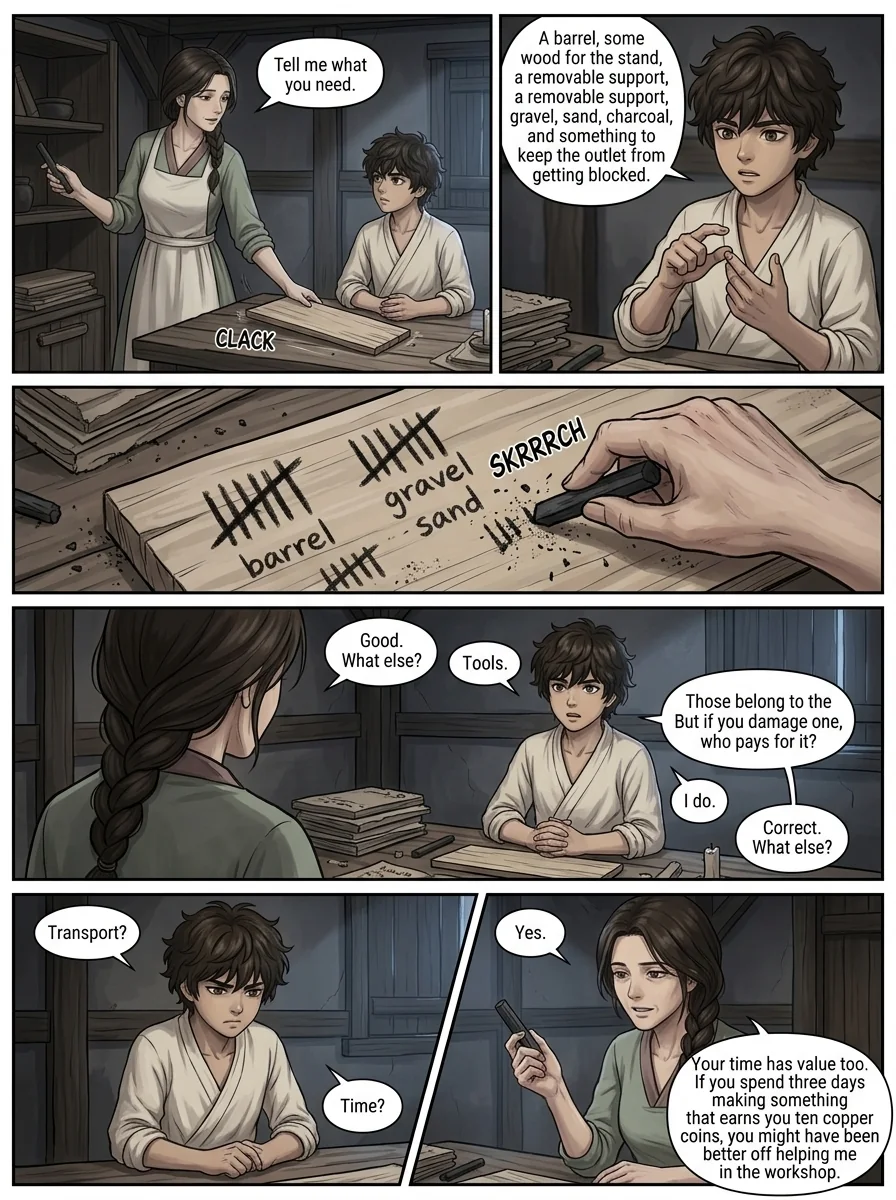
"Tell me what you need."
The boy began listing the materials.
"A barrel, some wood for the stand, a removable support, gravel, sand, charcoal, and something to keep the outlet from getting blocked."
"Good. What else?"
He thought for a moment.
"Tools."
"Those belong to the workshop. But if you damage one, who pays for it?"
"I do."
"Correct. What else?"
The boy frowned.
"Transport?"
"Yes."
"Time?"
His father nodded.
"Your time has value too. If you spend three days making something that earns you ten copper coins, you might have been better off helping me in the workshop."
The boy looked down at the board.
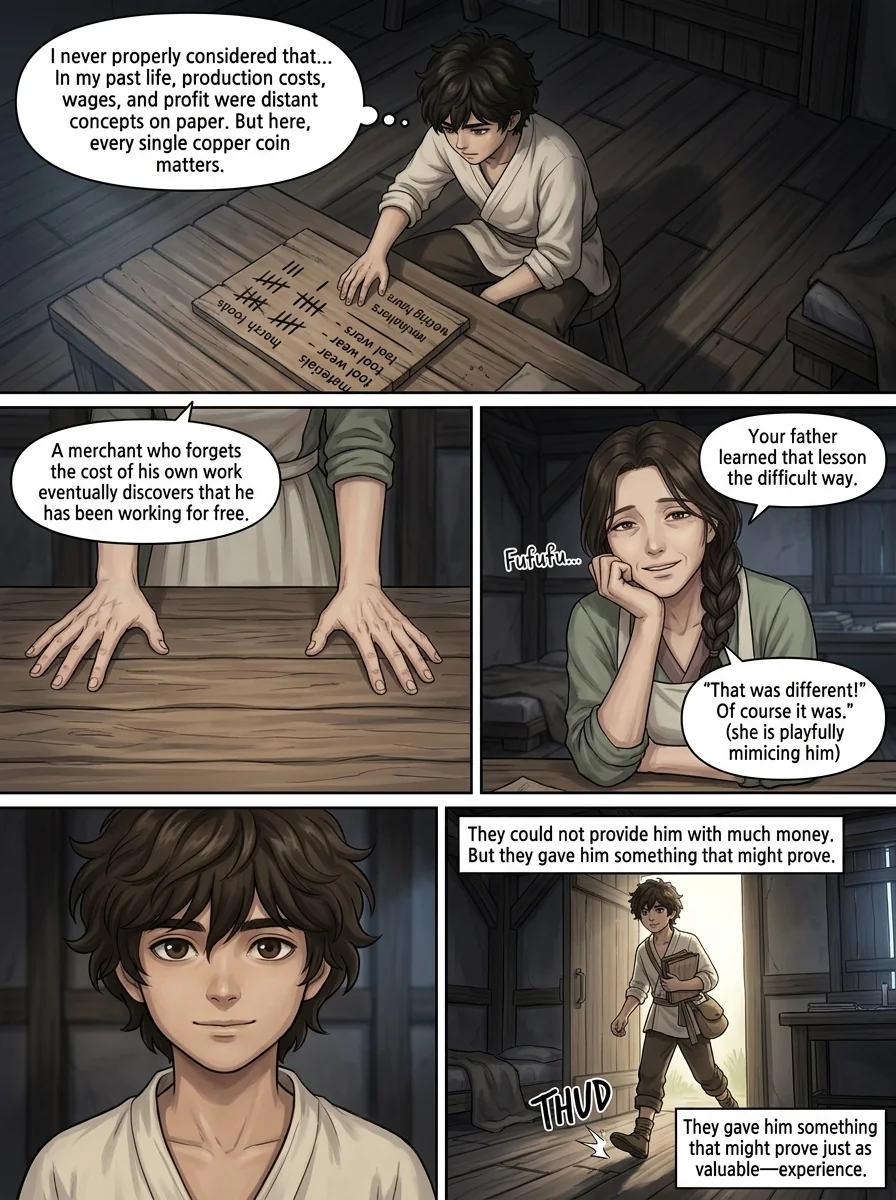
He had never properly considered that.
In his previous life, he remembered learning about production costs, wages, and profit. But those concepts had seemed distant and abstract. Here, every copper coin mattered.
His father continued.
"A merchant who forgets the cost of his own work eventually discovers that he has been working for free."
His mother chuckled.
"Your father learned that lesson the difficult way."
"That was different," his father protested.
"Of course it was."
The boy smiled.
For once, he was grateful that his parents were willing to teach him these things. They could not provide him with much money, but they could give him something that might prove just as valuable.
Experience.
After breakfast, he gathered his notes and headed toward his father's workshop.
## The Carpenter's Advice
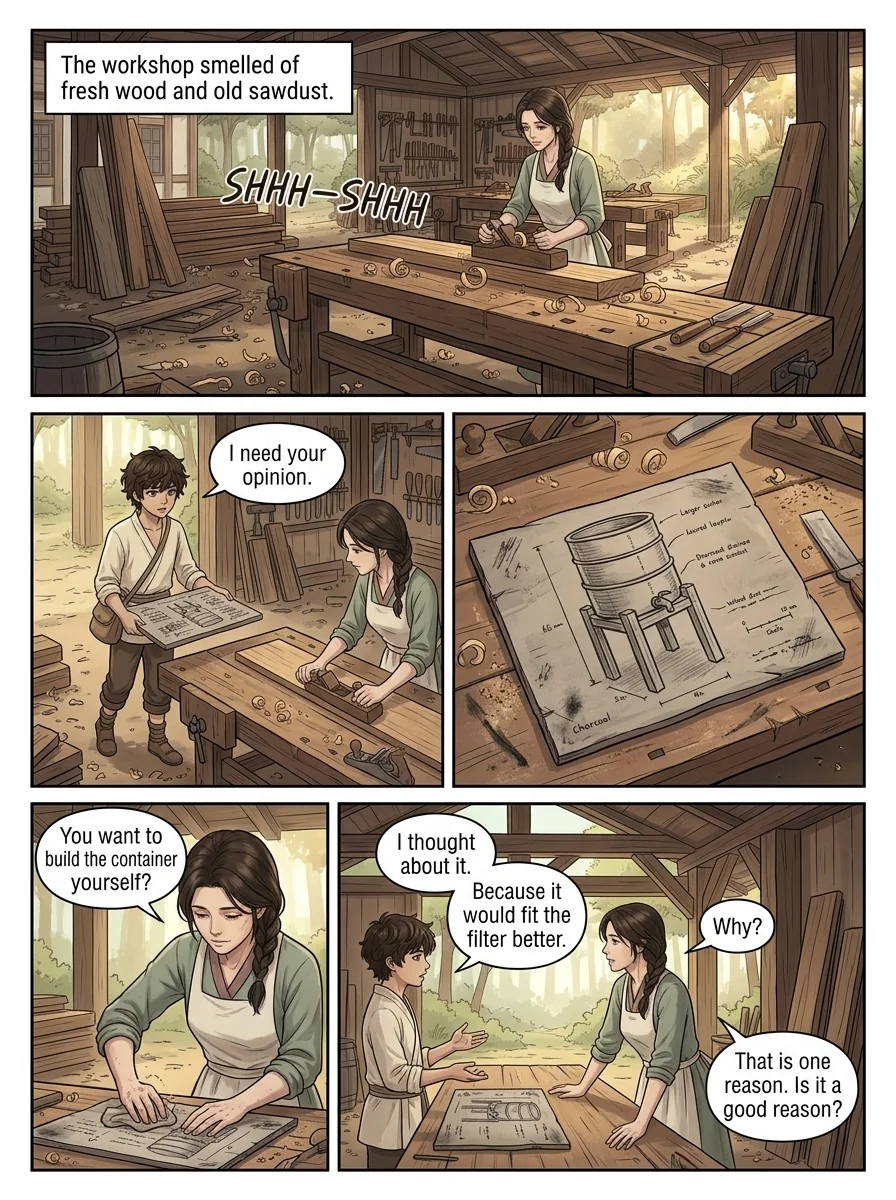
The workshop smelled of fresh wood and old sawdust.
His father was working on a chair for a merchant who lived near the village square. Several boards had already been cut, and the pieces were arranged neatly beside the workbench.
The boy placed his drawings on an empty section of the table.
"I need your opinion."
His father wiped his hands and examined them.
The drawings showed a large wooden container with several layers inside. Beneath it was a stand, and at the bottom was a small outlet.
His father studied the design.
"You want to build the container yourself?"
"I thought about it."
"Why?"
"Because it would fit the filter better."
"That is one reason. Is it a good reason?"
The boy hesitated.
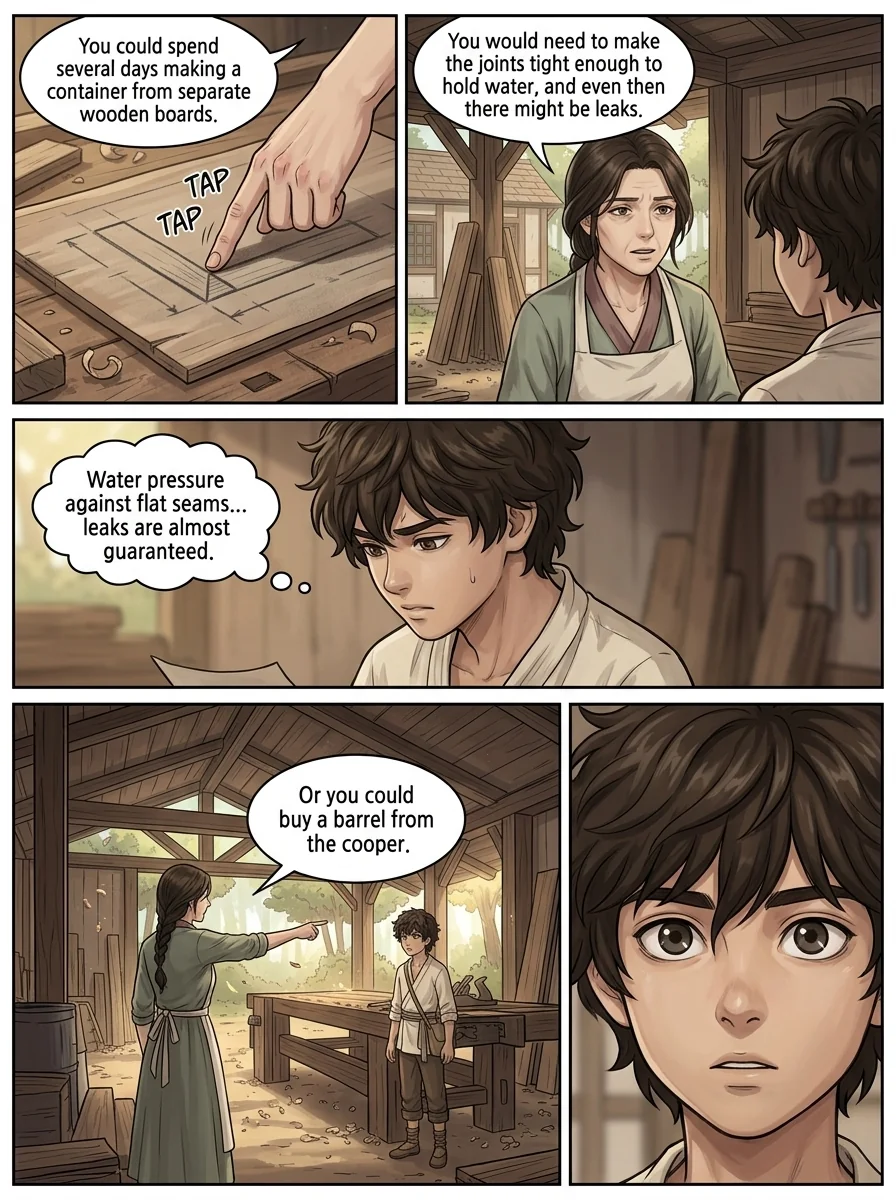
His father tapped the drawing.
"You could spend several days making a container from separate wooden boards. You would need to make the joints tight enough to hold water, and even then there might be leaks."
He pointed toward the back of the workshop.
"Or you could buy a barrel from the cooper."
The boy followed his finger.
A barrel.
Of course.
He had been so focused on inventing something that he had forgotten he did not need to invent every part of it.
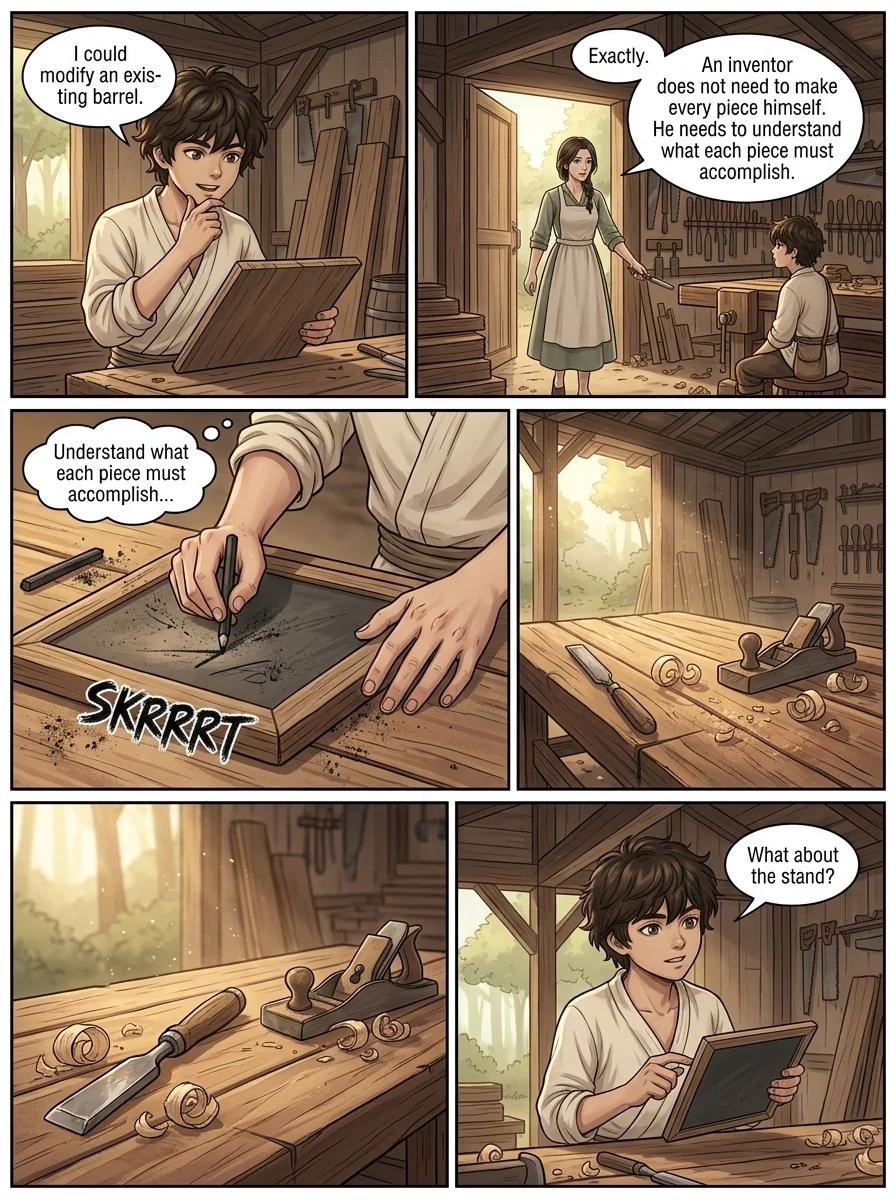
"I could modify an existing barrel."
"Exactly."
His father returned to the chair.
"An inventor does not need to make every piece himself. He needs to understand what each piece must accomplish."
The boy wrote that sentence down.
Then he looked at the drawing again.
"What about the stand?"
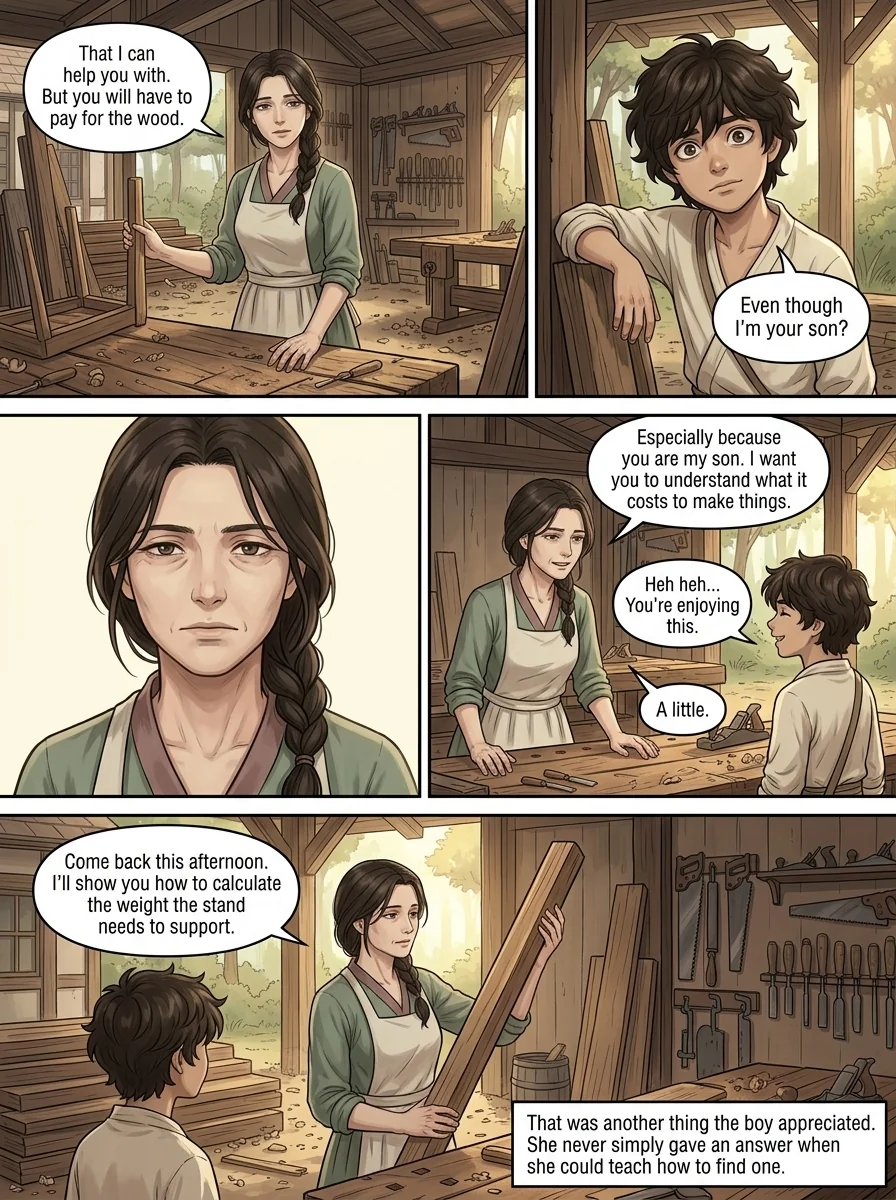
"That I can help you with. But you will have to pay for the wood."
"Even though I'm your son?"
His father gave him a serious look.
"Especially because you are my son. I want you to understand what it costs to make things."
The boy laughed.
"You're enjoying this."
"A little."
His father picked up a piece of wood and examined it.
"Come back this afternoon. I'll show you how to calculate the weight the stand needs to support."
That was another thing the boy appreciated about his father.
He never simply gave him an answer when he could teach him how to find one.
## A Visit to the Cooper
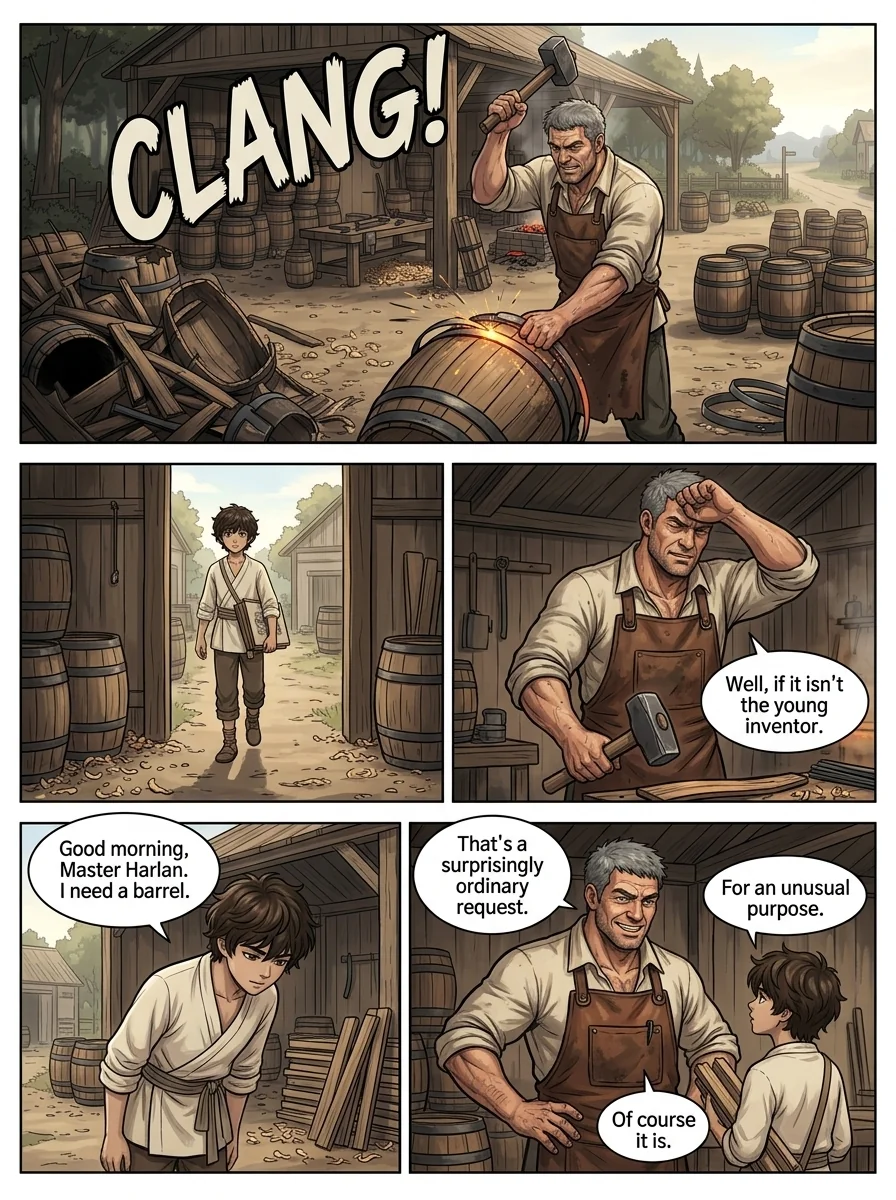
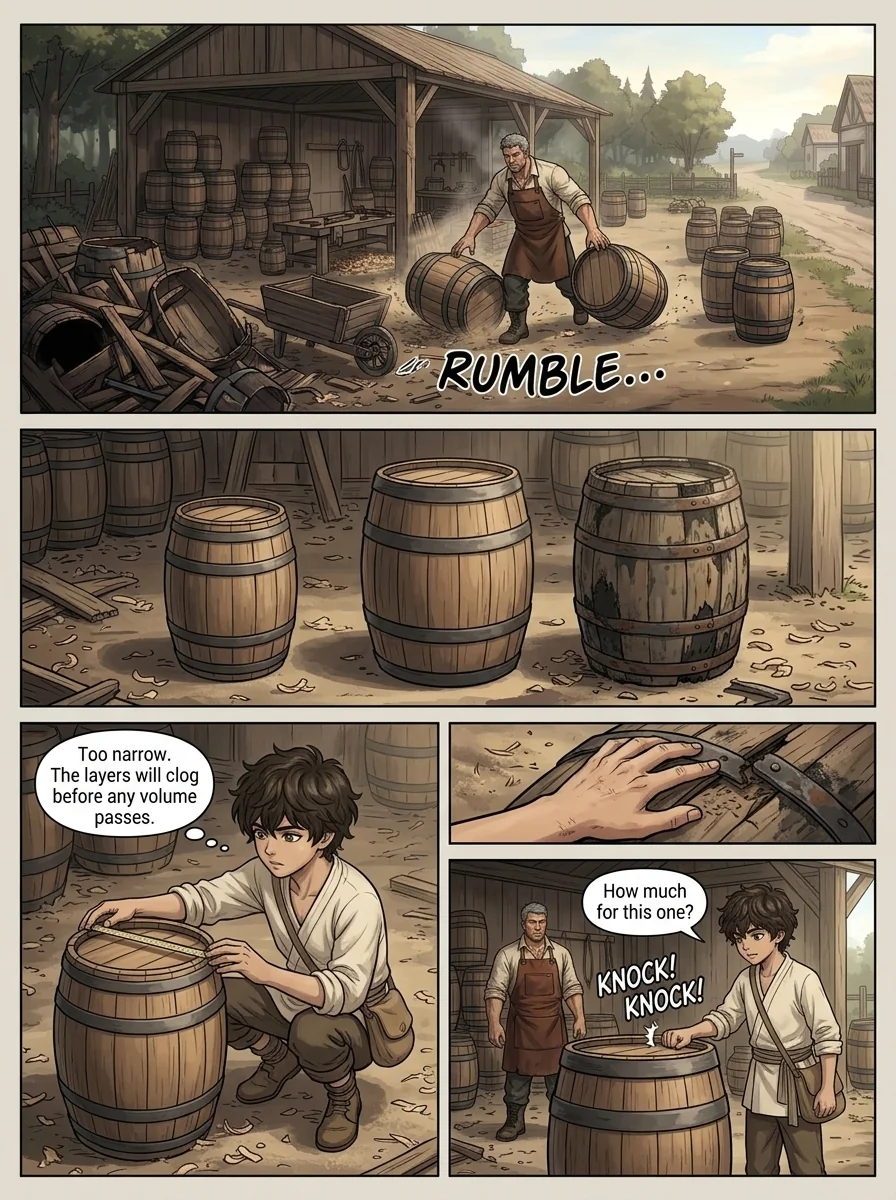
The village cooper's workshop stood near the road leading toward the market.
Barrels of different sizes occupied most of the space. Some were freshly assembled, their wooden staves held together by iron hoops. Others had been repaired so many times that their surfaces were dark with age.
The cooper himself was a broad-shouldered man named Harlan.
He looked up when the boy entered.
"Well, if it isn't the young inventor."
The boy smiled politely.
"Good morning, Master Harlan."
"What brings you here? Another strange request?"
"I need a barrel."
Harlan raised an eyebrow.
"That's a surprisingly ordinary request."
"For an unusual purpose."
The cooper laughed.
"Of course it is."
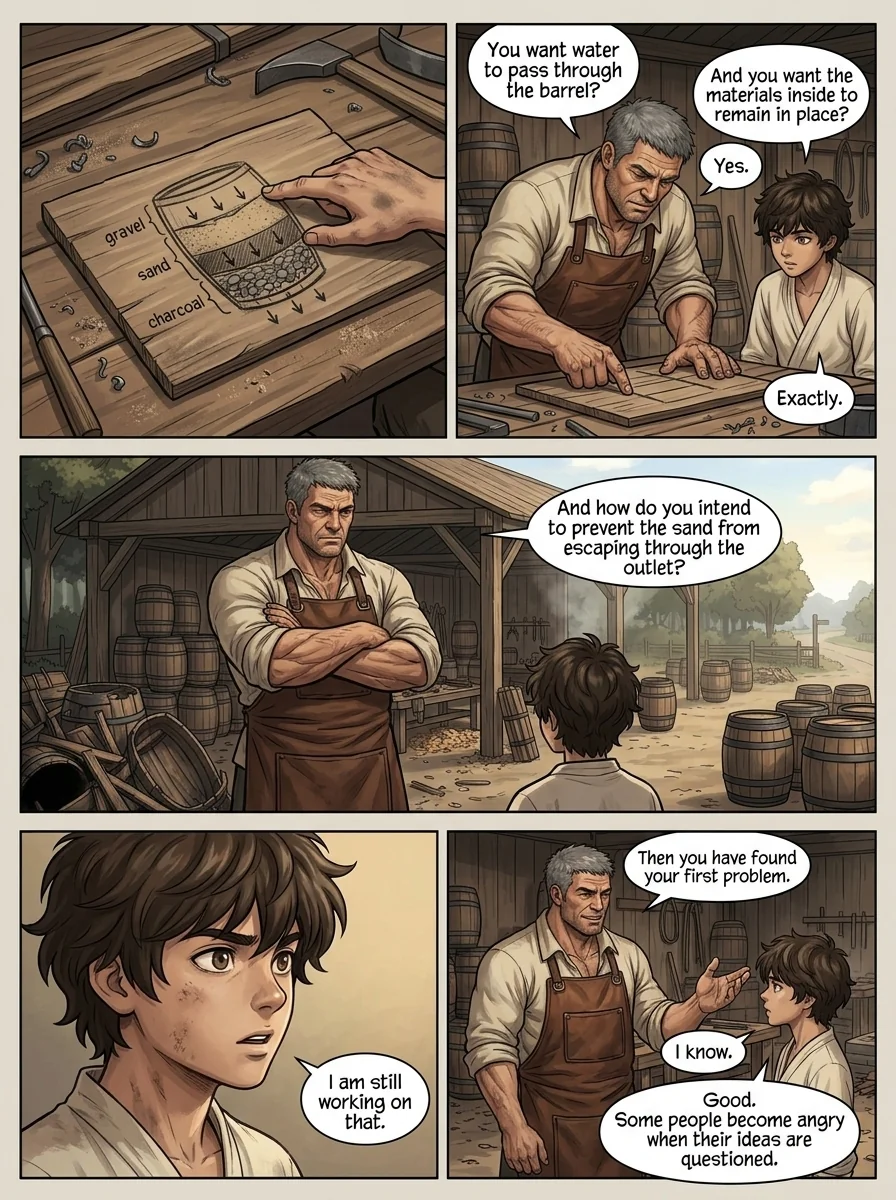
The boy explained the filter and showed him his drawings.
Harlan listened carefully, occasionally interrupting with questions.
"You want water to pass through the barrel?"
"Yes."
"And you want the materials inside to remain in place?"
"Exactly."
"And how do you intend to prevent the sand from escaping through the outlet?"
The boy hesitated.
"I am still working on that."
Harlan folded his arms.
"Then you have found your first problem."
"I know."
"Good. Some people become angry when their ideas are questioned."
The cooper walked toward the back of his workshop and returned with three barrels.
The first was small and narrow, originally intended for transporting wine.
The second was wider, with a thick wooden base.
The third was an old water barrel that had been repaired several times.
The boy inspected each one.
The smallest was too narrow. The old barrel was too damaged.
The second seemed suitable.
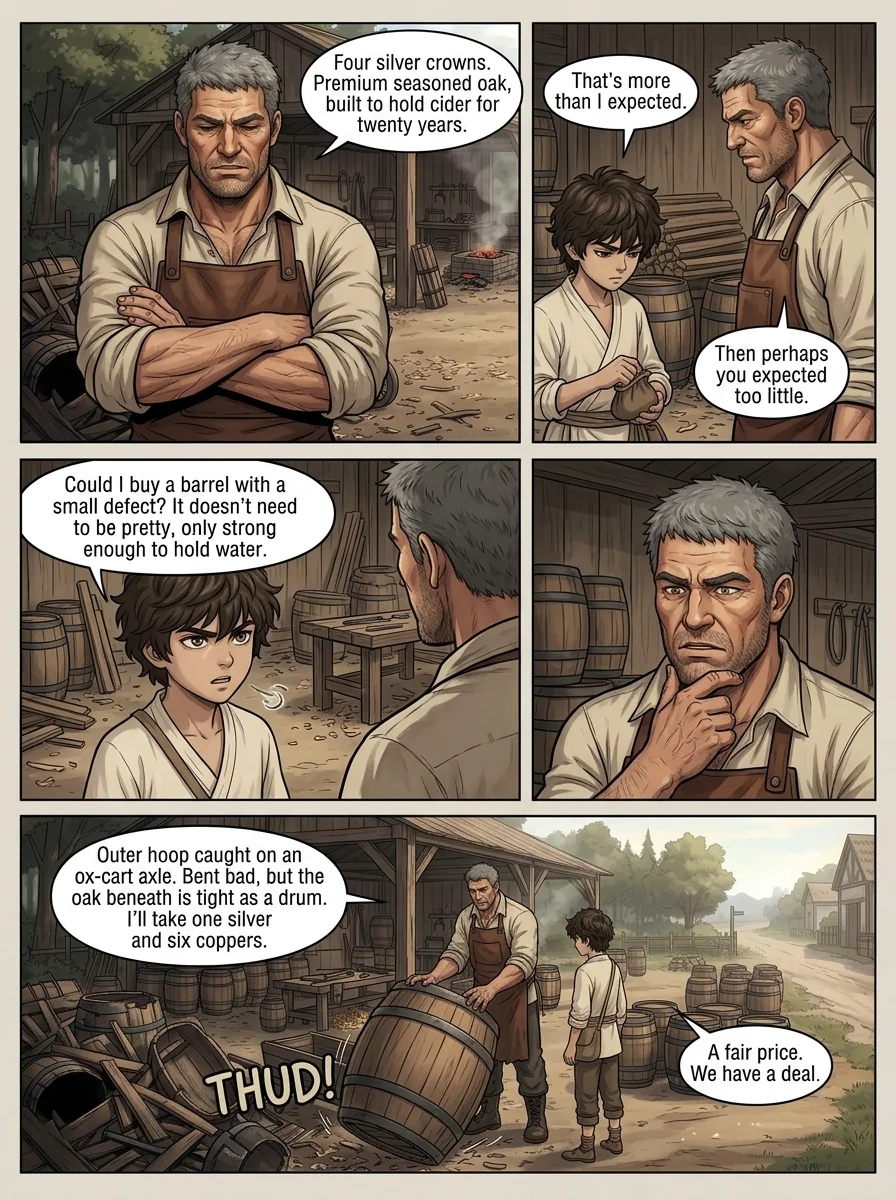
"How much for this one?"
Harlan named a price.
The boy frowned.
"That's more than I expected."
"Then perhaps you expected too little."
The boy sighed.
"Could I buy a barrel with a small defect? It doesn't need to be pretty, only strong enough to hold water."
Harlan considered that.
After searching through his workshop, he found a barrel with a damaged outer hoop. The wood itself was still sound.
It was not particularly attractive, but it would serve.
They agreed on a lower price.
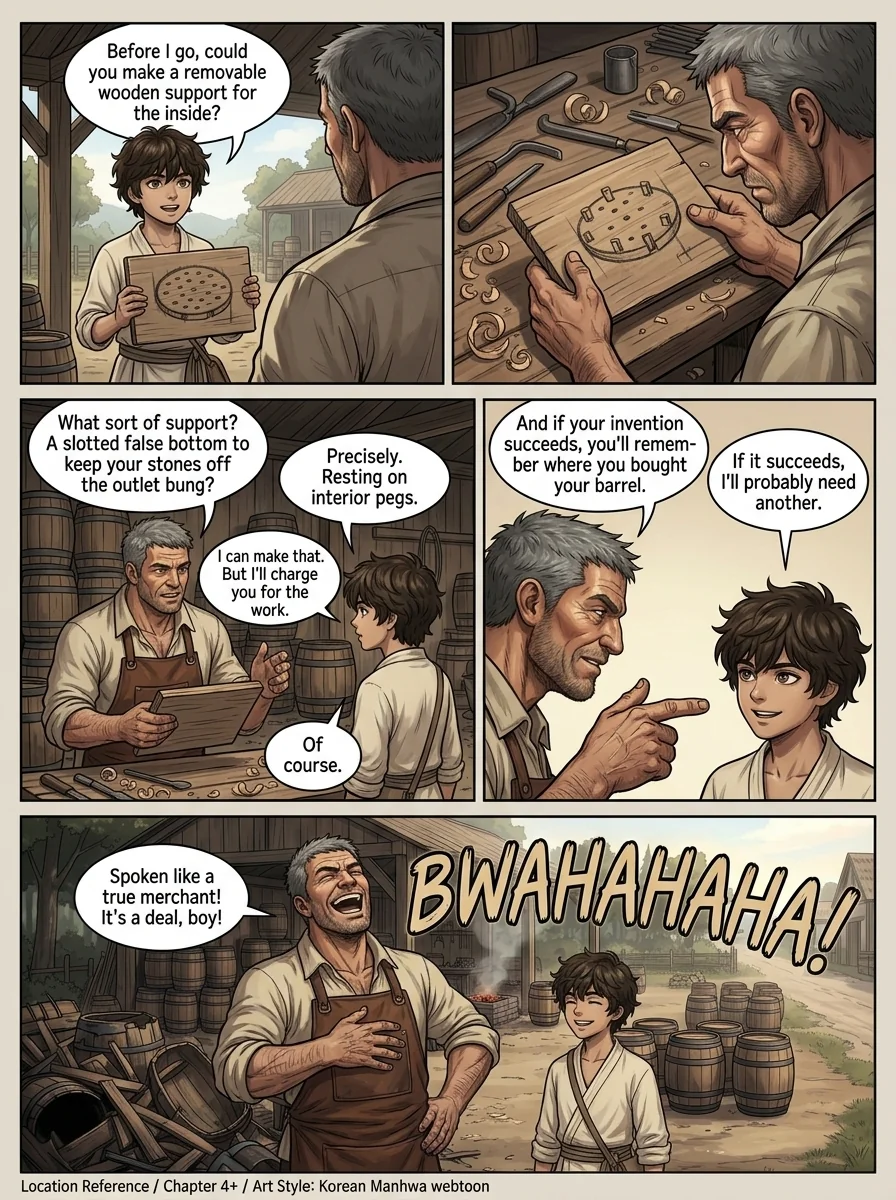
Before leaving, the boy asked whether Harlan could make a removable wooden support for the inside.
"What sort of support?"
He explained the design.
Harlan examined the drawing and nodded slowly.
"I can make that. But I'll charge you for the work."
"Of course."
"And if your invention succeeds, you'll remember where you bought your barrel."
The boy smiled.
"If it succeeds, I'll probably need another."
That earned him a proper laugh.
## The First Large Prototype
The barrel arrived at his father's workshop two days later.
The boy had already prepared most of the other materials.
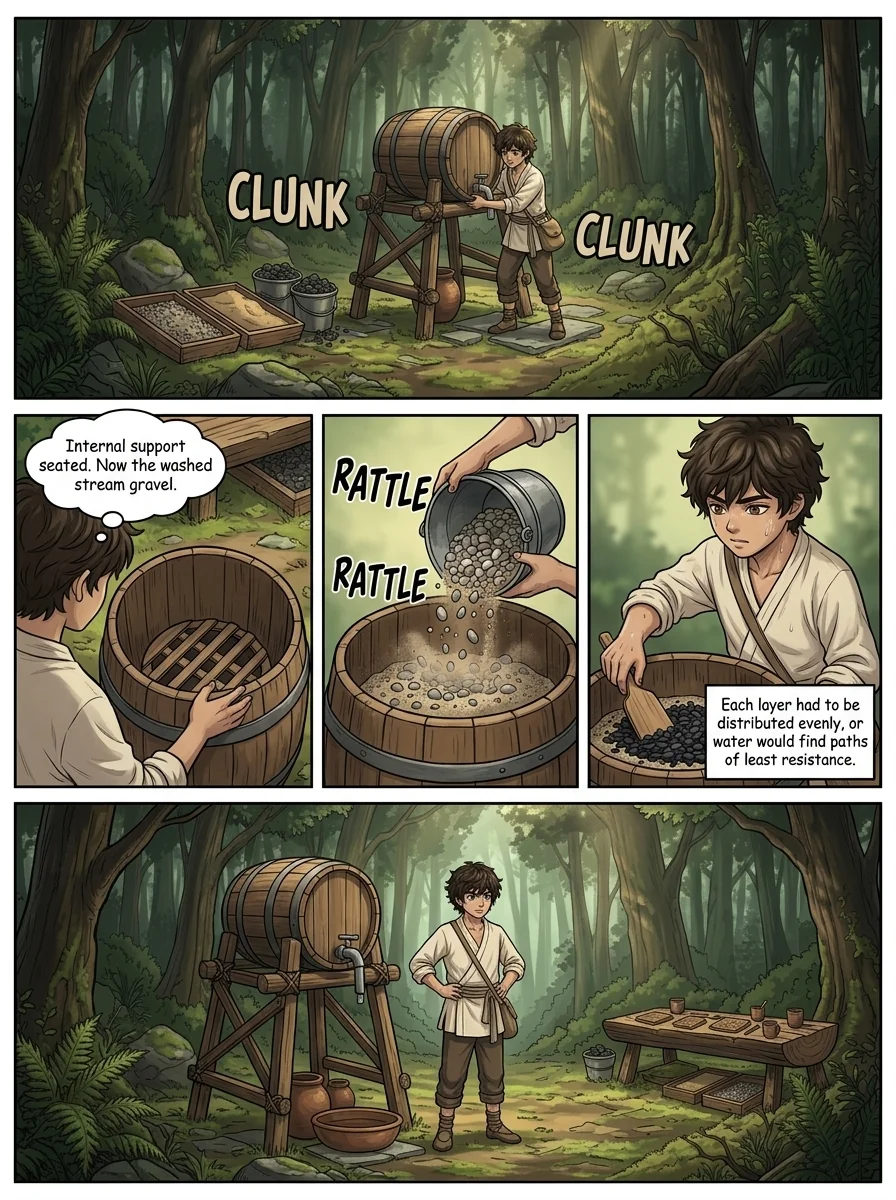
He had collected gravel from a nearby stream, washed it repeatedly, and separated it by size. The sand had been washed until the water running through it was no longer visibly muddy. The charcoal had been broken into smaller pieces and rinsed to remove loose dust.
He knew that cleanliness mattered.
There was little point in constructing a filter only to fill it with dirty materials.
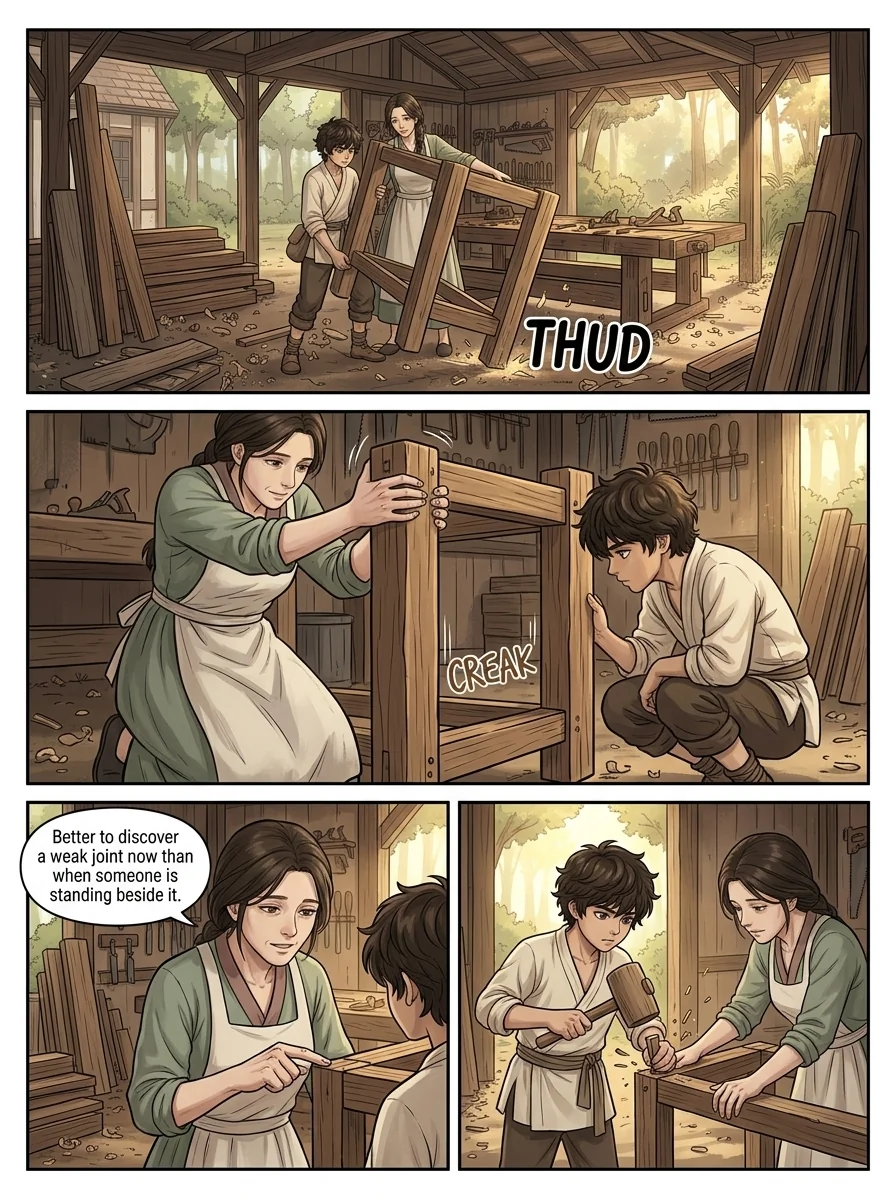
His father helped him build a sturdy stand.
The boy wanted the barrel to sit high enough for the water to flow into a collection vessel beneath it. The stand also needed to remain stable when the barrel was full.
His father insisted on testing the joints before allowing him to use it.
"Better to discover a weak joint now than when someone is standing beside it," he explained.
Together, they checked the supports and reinforced one corner.
Once the stand was finished, the boy carried the barrel to his little workshop in the woods.
He placed the internal support inside and began arranging the filtering materials.
The gravel went in first, followed by the sand and prepared charcoal, with the layers arranged according to his latest design.
He worked slowly.
Each layer had to be distributed evenly.
When he finished, he stepped back and admired his work.
It looked impressive.
It was also considerably heavier than his first filter.
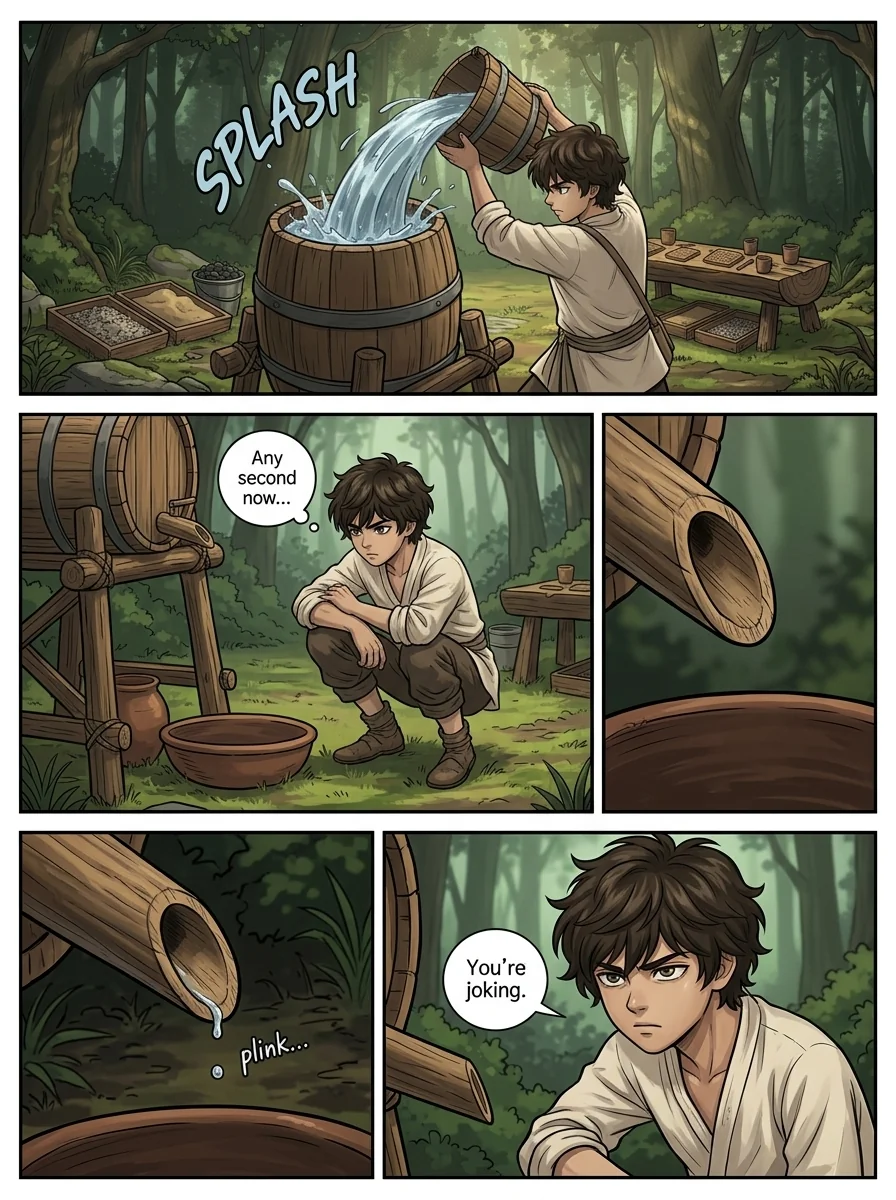
He placed a collection vessel underneath and poured in the first bucket of water.
Nothing happened.
He waited.
A few drops emerged from the outlet.
He waited longer.
Another few drops followed.
The boy stared at the barrel.
"You're joking."
The barrel remained silent.
He checked the outlet. It was not blocked. He examined the layers, looking for an obvious mistake.
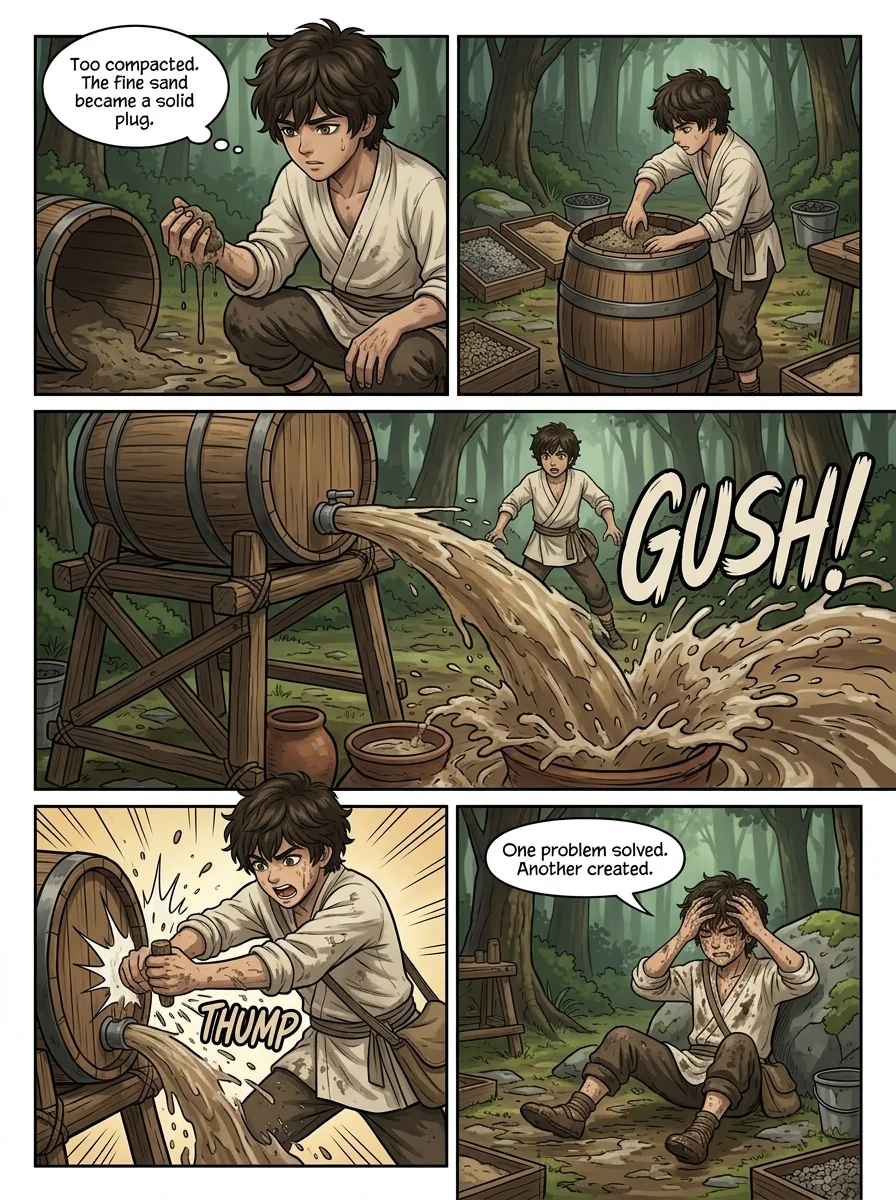
The problem was the filtering material. He had packed too much fine sand into the barrel, and the water was passing through it painfully slowly.
His first instinct was to remove some of the sand.
Instead, he stopped and thought.
The manor did not merely need cleaner-looking water. It needed enough filtered water to make the device useful.
A filter that produced a cup every few minutes would be little better than his original small version.
He emptied the barrel and began again.
This time, he adjusted the arrangement and paid greater attention to how evenly the materials were distributed.
The second attempt flowed more freely.
Unfortunately, the water that emerged carried fine particles of sand.
The boy closed the outlet and groaned.
One problem solved. Another created.
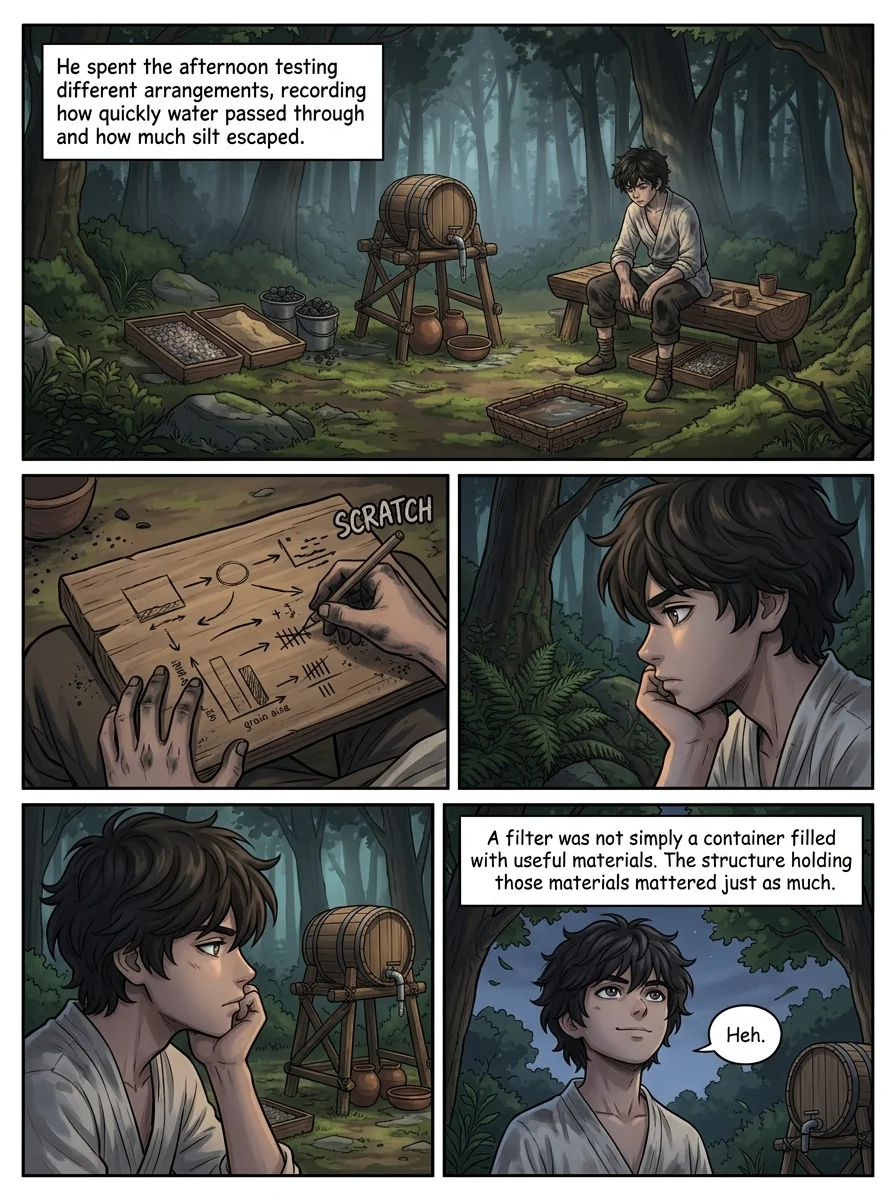
He spent the afternoon testing different arrangements, recording how quickly water passed through and how much visible material escaped.
By evening, he had learned something important.
A filter was not simply a container filled with useful materials.
The structure holding those materials mattered just as much.
## A Lesson from the Past
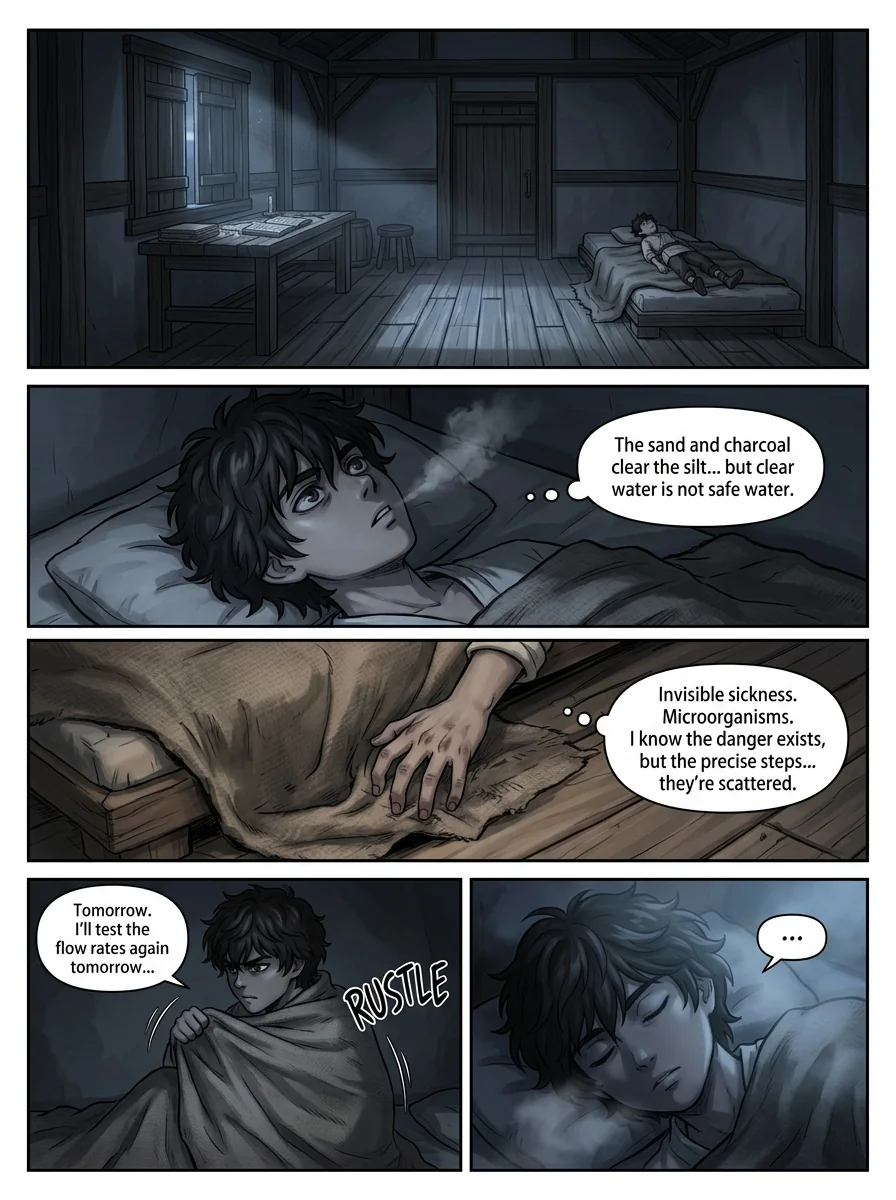
That night, the boy lay in bed thinking about the failed experiments.
He had made progress, but not enough.
His little filter had been useful for improving the appearance of water. The larger version could process more, but it still had weaknesses.
And even if he perfected the physical construction, the problem of drinking water remained.
He closed his eyes.
His thoughts drifted toward memories of his previous life.
He remembered school lessons, public information posters, and the familiar sight of water being boiled in kitchens.
He remembered something about microorganisms.
Something about temperature.
Something about how long water needed to be heated.
But the details were scattered.
He knew that boiling water could make it safer to drink, but he wanted to remember the proper method. He also remembered that water could become contaminated again after treatment if it was handled carelessly.
He turned over.
Tomorrow, he would have to think about it again.
Eventually, exhaustion overcame him.
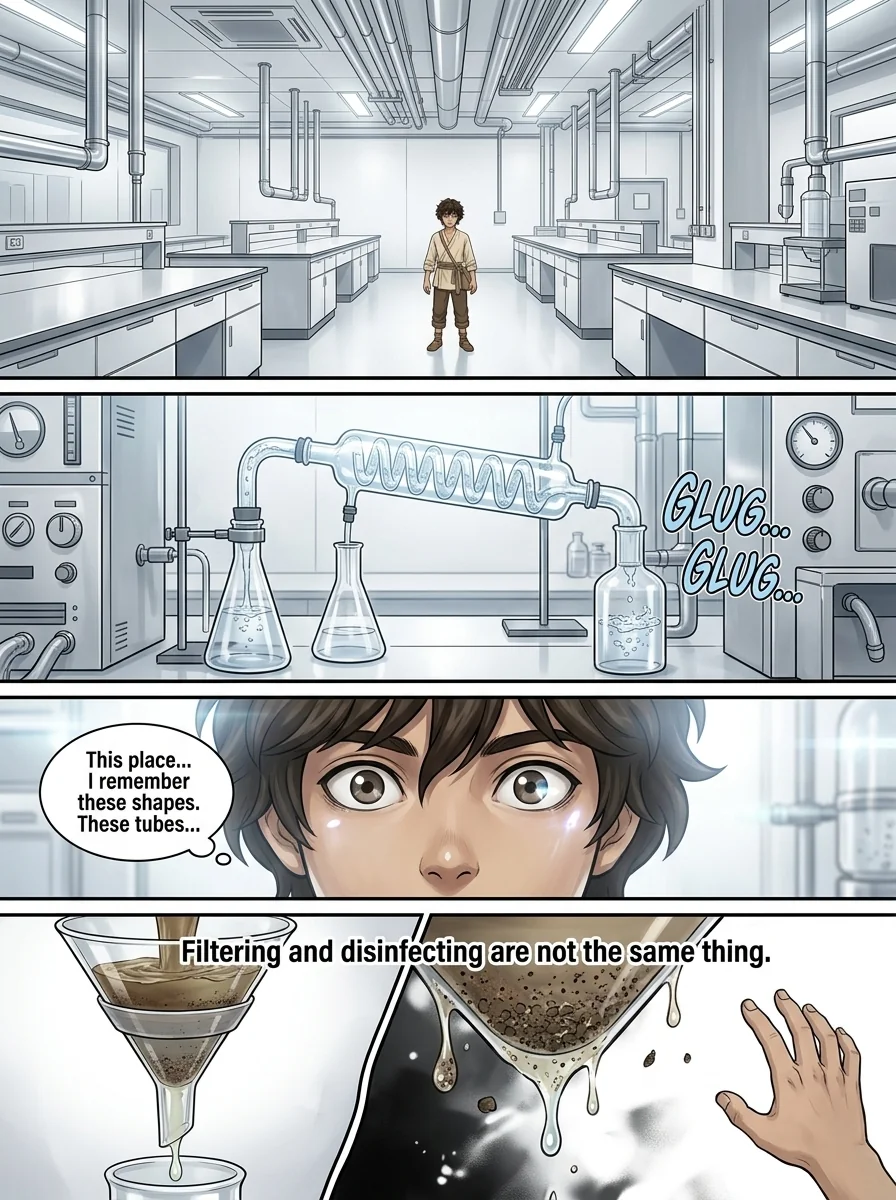
And then he dreamed.
He was standing in a place that did not belong to Greymoor.
White walls surrounded him. Metal pipes ran along the ceiling. A large glass vessel stood on a table, and water moved through a series of containers connected by narrow tubes.
He could not read the labels.
Yet the purpose of the equipment seemed strangely familiar.
The scene changed.
He saw water being poured through a filter. Dirt and particles remained behind while clearer water flowed into another container.
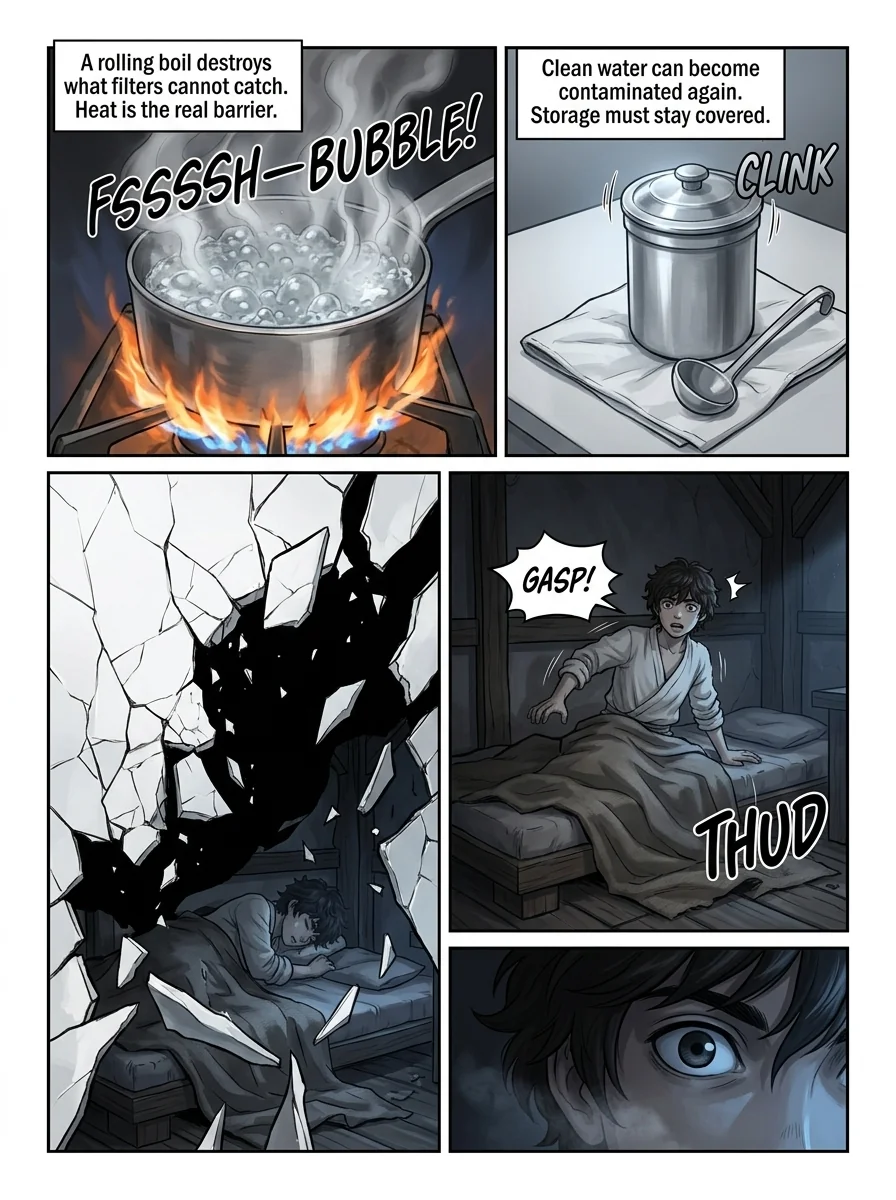
Then he saw a pot being placed over a fire.
A familiar voice spoke.
"Filtering and disinfecting are not the same thing."
The boy watched the water heat.
The memory became clearer.
Boiling water was a simple and effective way to kill many disease-causing organisms. It did not matter whether the water looked dirty or clear. What mattered was that the water reached the proper temperature and was kept at a rolling boil for the recommended period.
Another image appeared.
A clean container with a lid.
A ladle resting beside it.
The voice continued.
"Clean water can become contaminated again."
The boy watched someone pour the boiled water into the covered container.
Then the scene faded.
He awoke suddenly.
For several seconds, he did not move.
The room was dark. His blanket had slipped to the floor, and the cold air made him shiver.
Then he sat upright.
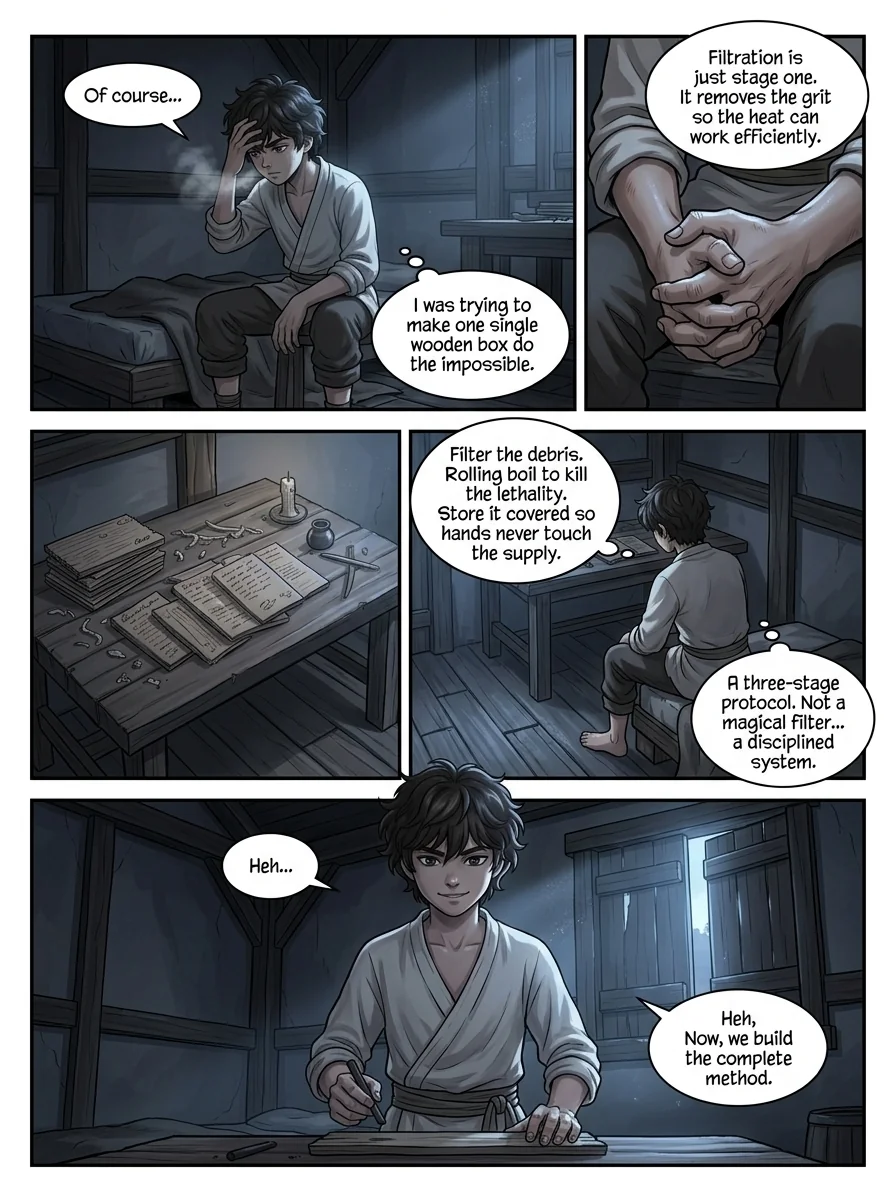
"Of course."
He had been trying to make one device accomplish everything.
But the simplest solution was not necessarily a more complicated filter.
It was a reliable process.
First, remove as much dirt as possible.
Then treat the water properly.
Finally, protect it from becoming contaminated again.
He had remembered the missing piece.
Not a magical substance.
Not a miraculous filter.
Simply the knowledge that he had once taken for granted.
## The Complete Method
The following morning, the boy was out of bed before sunrise.
He went to the kitchen and found his mother preparing breakfast.
"Mother, do we have a clean cooking pot that isn't being used?"
She looked at him.
"Good morning to you too."
"Sorry. Good morning."
She laughed.
"What do you need the pot for?"
"I want to test something."
His mother studied his expression.
"Another invention?"
"An improvement to the water filter."
She pointed toward a spare pot near the wall.
"That one is available. But don't damage it."
"I won't."
He took the pot and carried it to his workshop.
His plan was straightforward.
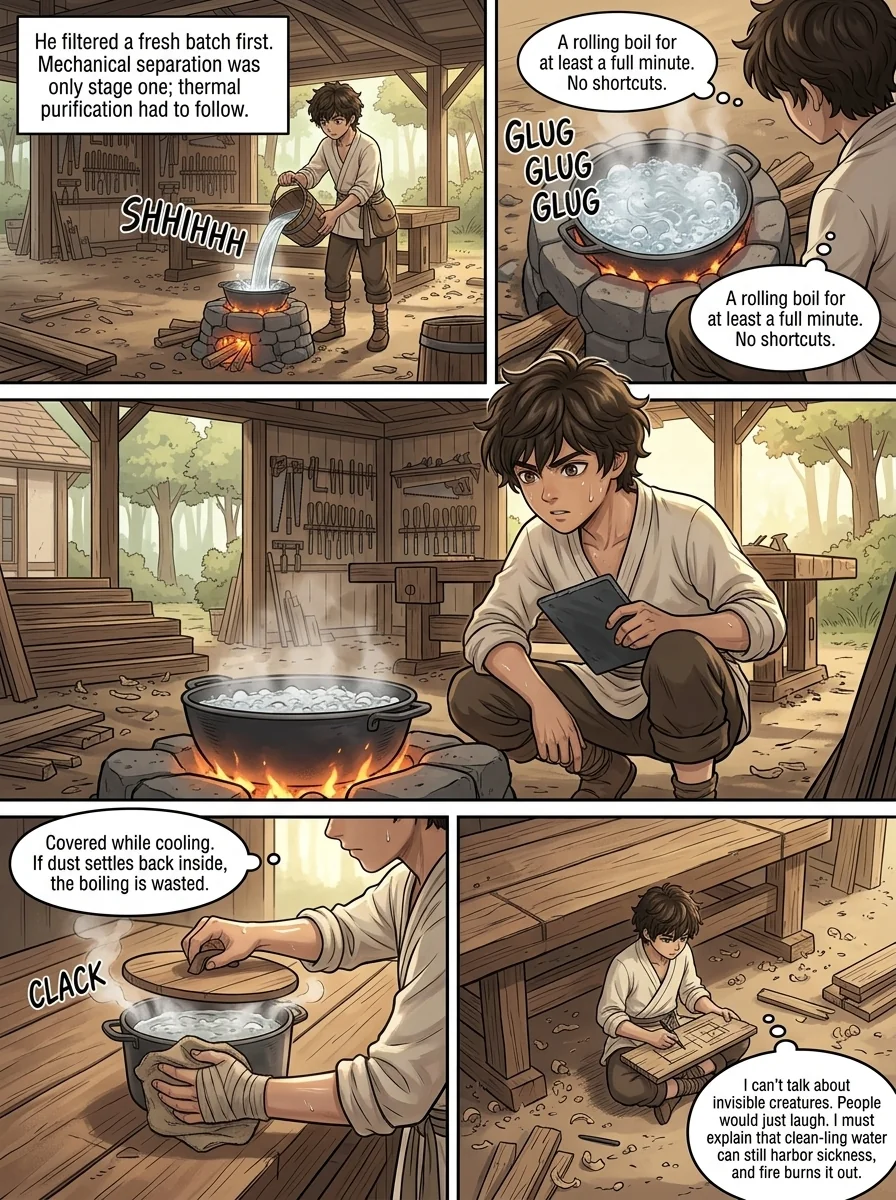
He would filter the water first, then boil it separately. Once it had been treated, he would allow it to cool in a clean, covered vessel.
He knew that boiling needed to be done properly. His memory suggested a rolling boil for at least one minute, with a longer period at higher elevations. Greymoor was not particularly high, but he intended to follow the safest practical guidance he remembered.
He filtered a batch of water.
Then he poured it into the cooking pot and placed it over a fire.
He watched carefully as the water heated.
When it reached a rolling boil, he maintained it for the required time.
Afterward, he removed the pot from the fire and covered it with a clean lid.
He did not drink it immediately.
Instead, he repeated the process and checked his notes.
He also began thinking about how to explain the method to someone who had never heard of invisible organisms.
He could not simply tell people that the water contained tiny creatures.
Most would probably laugh.
Instead, he would explain that water could carry sickness even when it looked clean, and that boiling was necessary to make it safer for drinking.
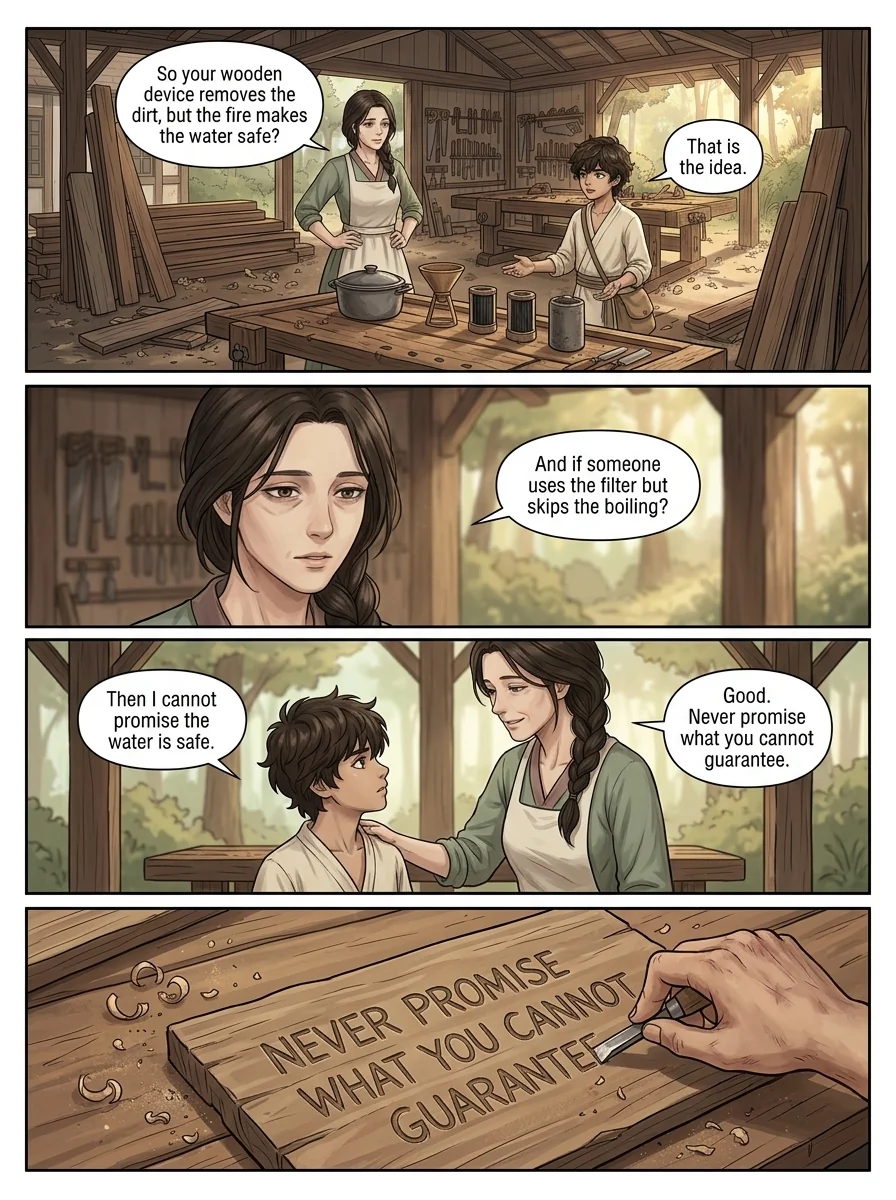
His mother came to inspect his work later that morning.
"So your wooden device removes the dirt," she said, "but the fire makes the water safe?"
"That is the idea."
"And if someone uses the filter but skips the boiling?"
"Then I cannot promise the water is safe."
His mother nodded.
"Good. Never promise what you cannot guarantee."
He wrote those words into his notes.
## Testing the Routine
Over the following days, the boy worked on making the process practical.
He improved the filter so that it could produce clearer water more consistently. He also designed a separate collection vessel that could be covered after the water had been boiled and cooled.
The problem was not simply making the device work once.
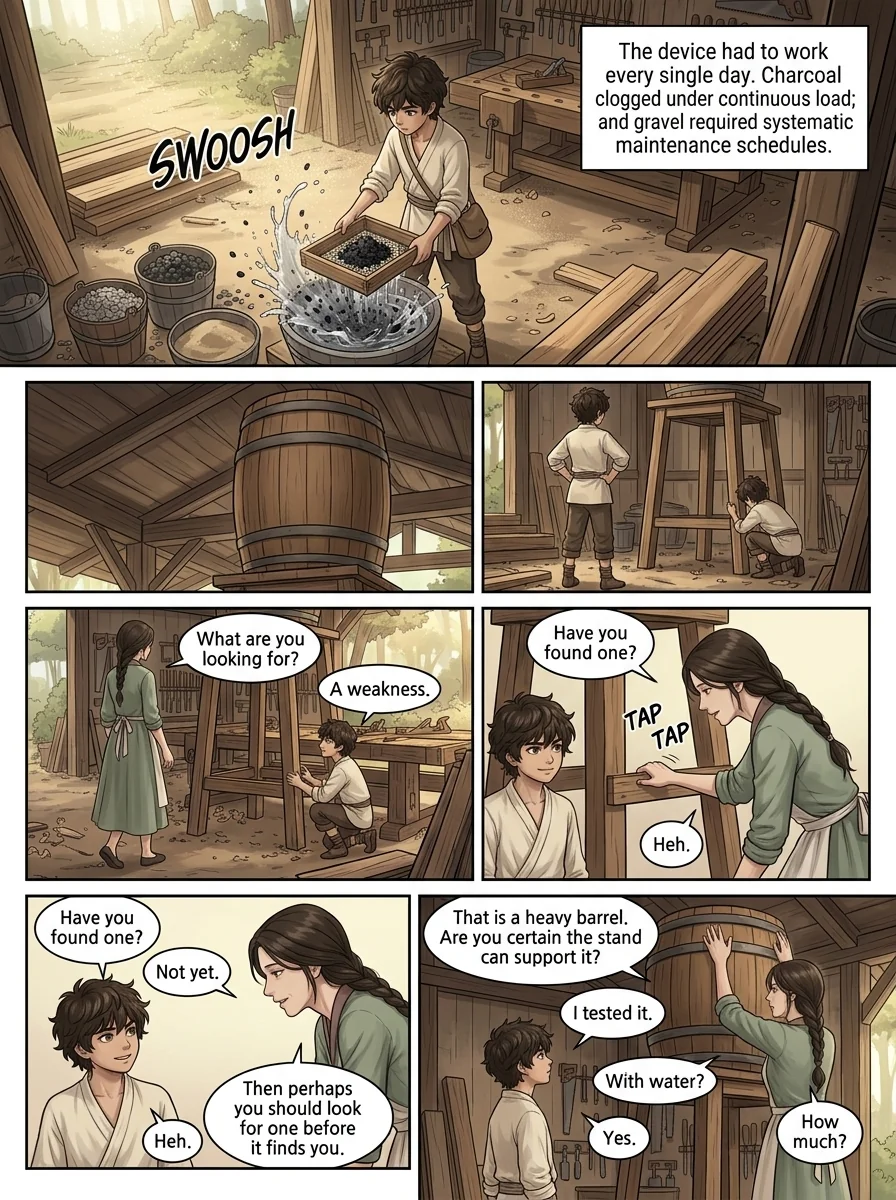
It had to work every day.
He tested different quantities of water, recorded how long filtration took, and checked how often the filtering materials needed attention.
He also learned that the charcoal could become clogged and that the sand and gravel needed regular cleaning or replacement.
His first large prototype was far from perfect.
But each experiment taught him something.
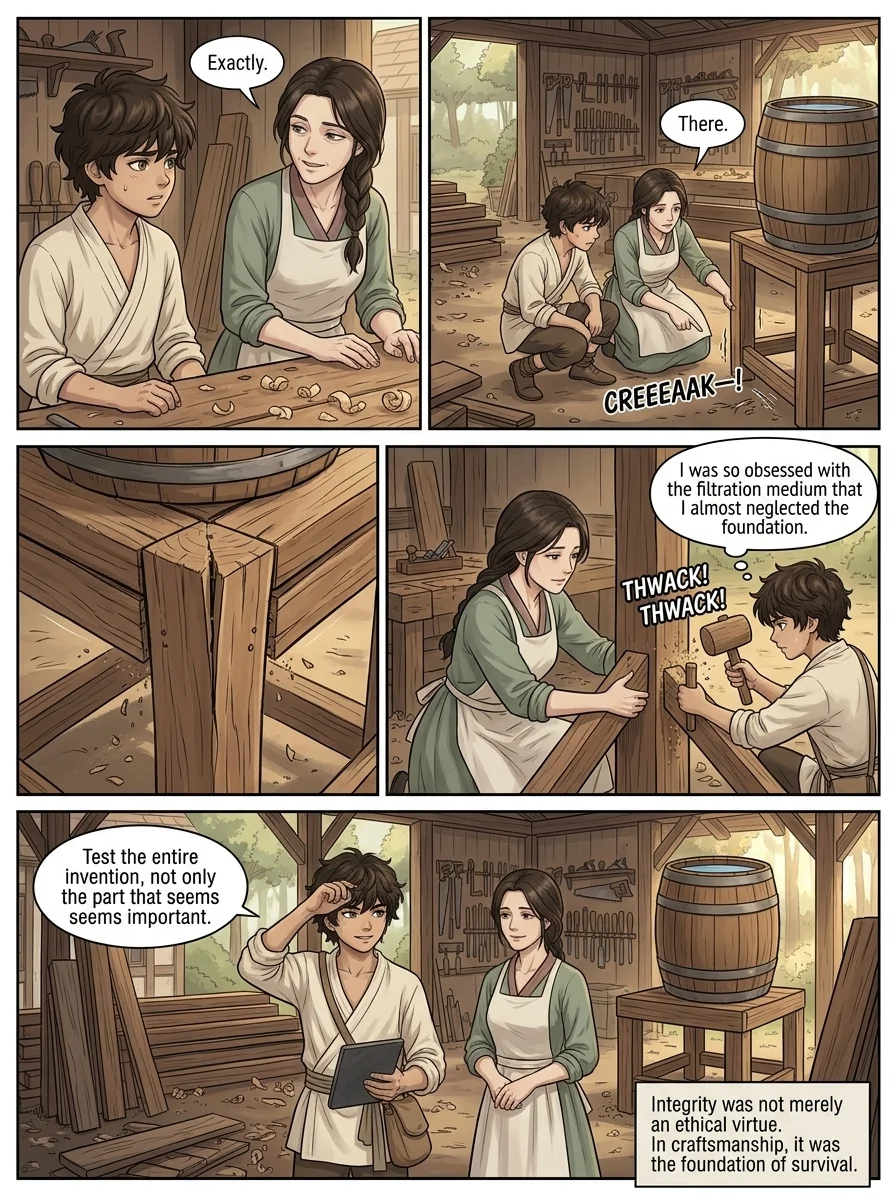
One afternoon, his father found him examining the wooden support.
"What are you looking for?"
"A weakness."
His father leaned closer.
"Have you found one?"
"Not yet."
"Then perhaps you should look for one before it finds you."
The boy laughed.
His father examined the construction.
"That is a heavy barrel. Are you certain the stand can support it?"
"I tested it."
"With water?"
"Yes."
"How much?"
The boy hesitated.
His father raised an eyebrow.
"Exactly."
They tested it again, gradually increasing the weight.
One of the joints began to shift.
His father pointed at it.
"There."
The boy stared at the joint.
He had been so focused on the filter itself that he had nearly overlooked the stand.
They reinforced it together.
This time, the structure remained stable.
The boy added another note to his records.
**Test the entire invention, not only the part that seems important.**
## The Housekeeper's Request
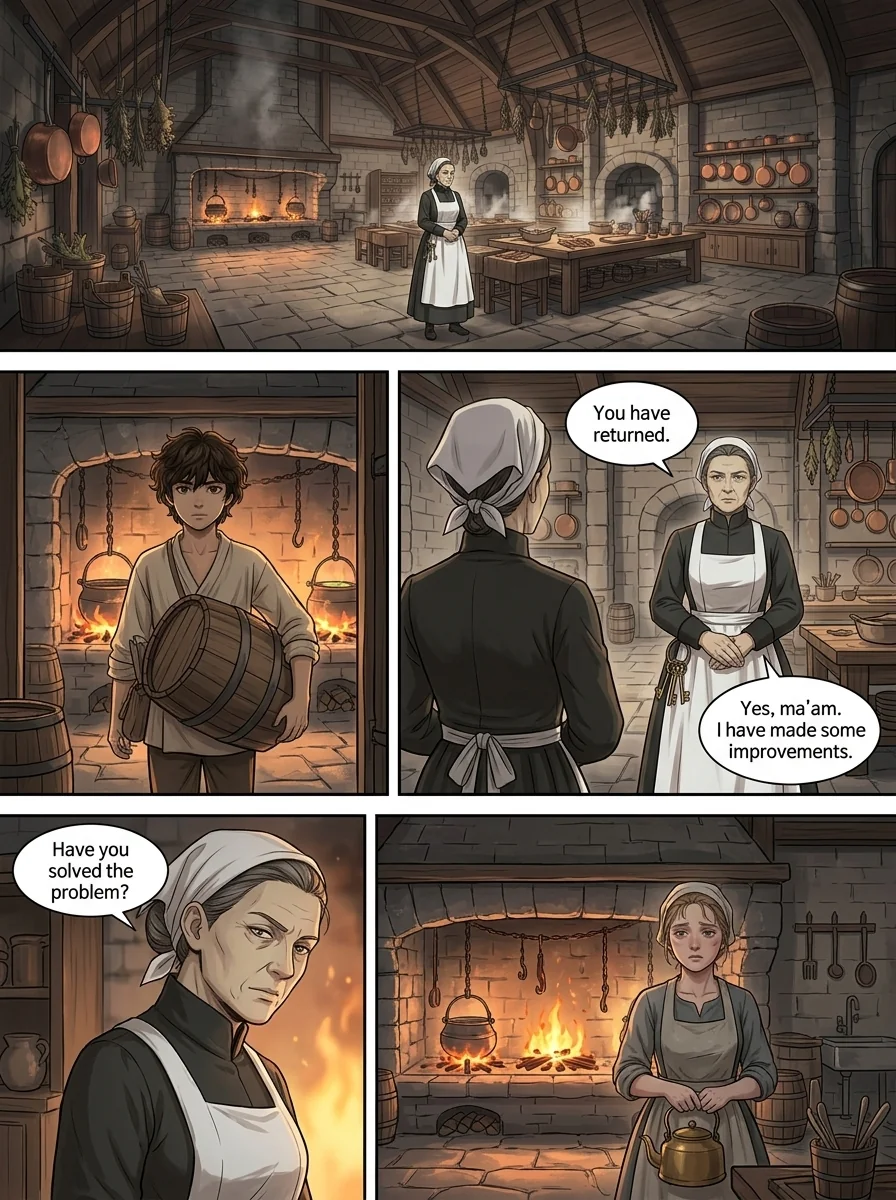
When he next visited his mother at the manor, he brought the improved filter with him.
The head housekeeper was waiting in the kitchen when he arrived.
"You have returned," she said.
"Yes, ma'am. I have made some improvements."
"Have you solved the problem?"
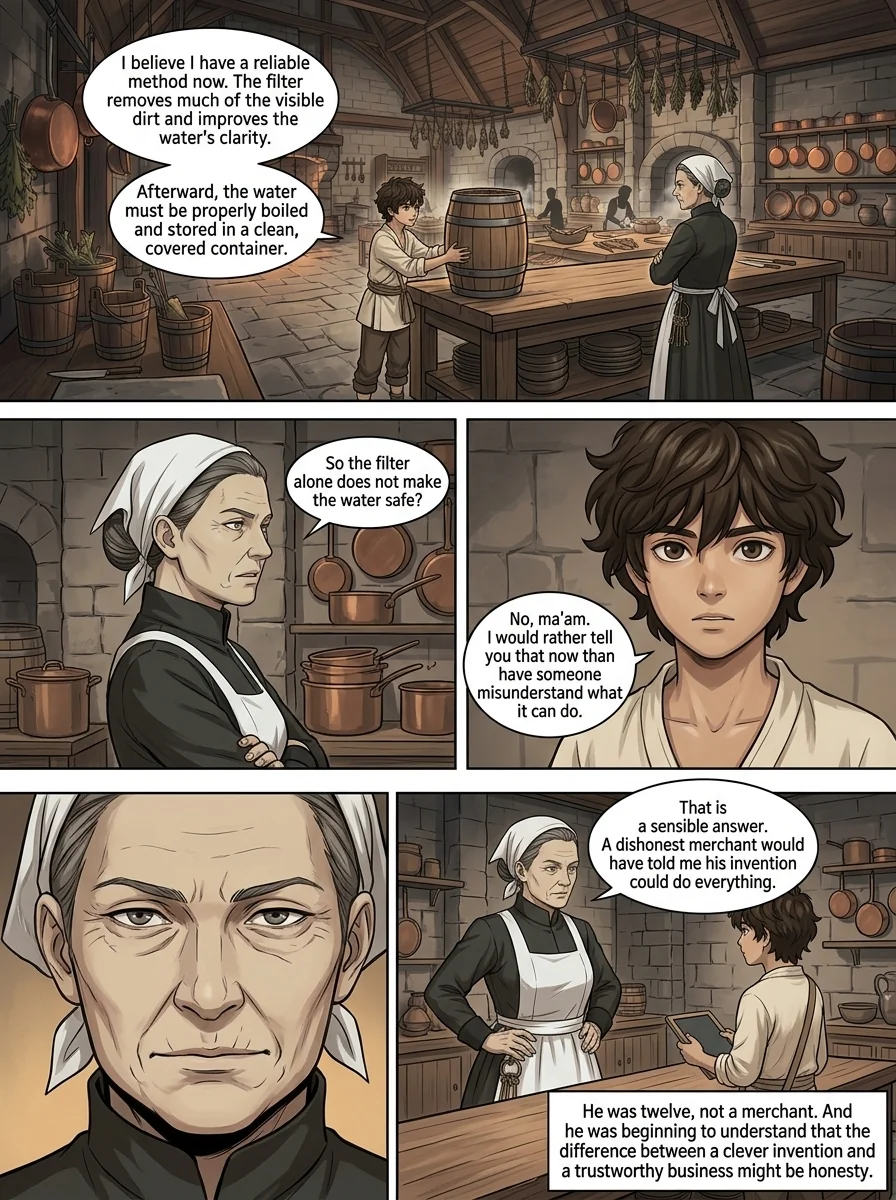
"I believe I have a reliable method now. The filter removes much of the visible dirt and improves the water's clarity. Afterward, the water must be properly boiled and stored in a clean, covered container."
The housekeeper studied him.
"So the filter alone does not make the water safe?"
"No, ma'am. I would rather tell you that now than have someone misunderstand what it can do."
For a moment, she said nothing.
Then she gave a small, approving nod.
"That is a sensible answer. A dishonest merchant would have told me his invention could do everything."
The boy resisted the urge to smile.
He was twelve, not a merchant, and he was beginning to understand that the difference between a clever invention and a trustworthy business might be honesty.
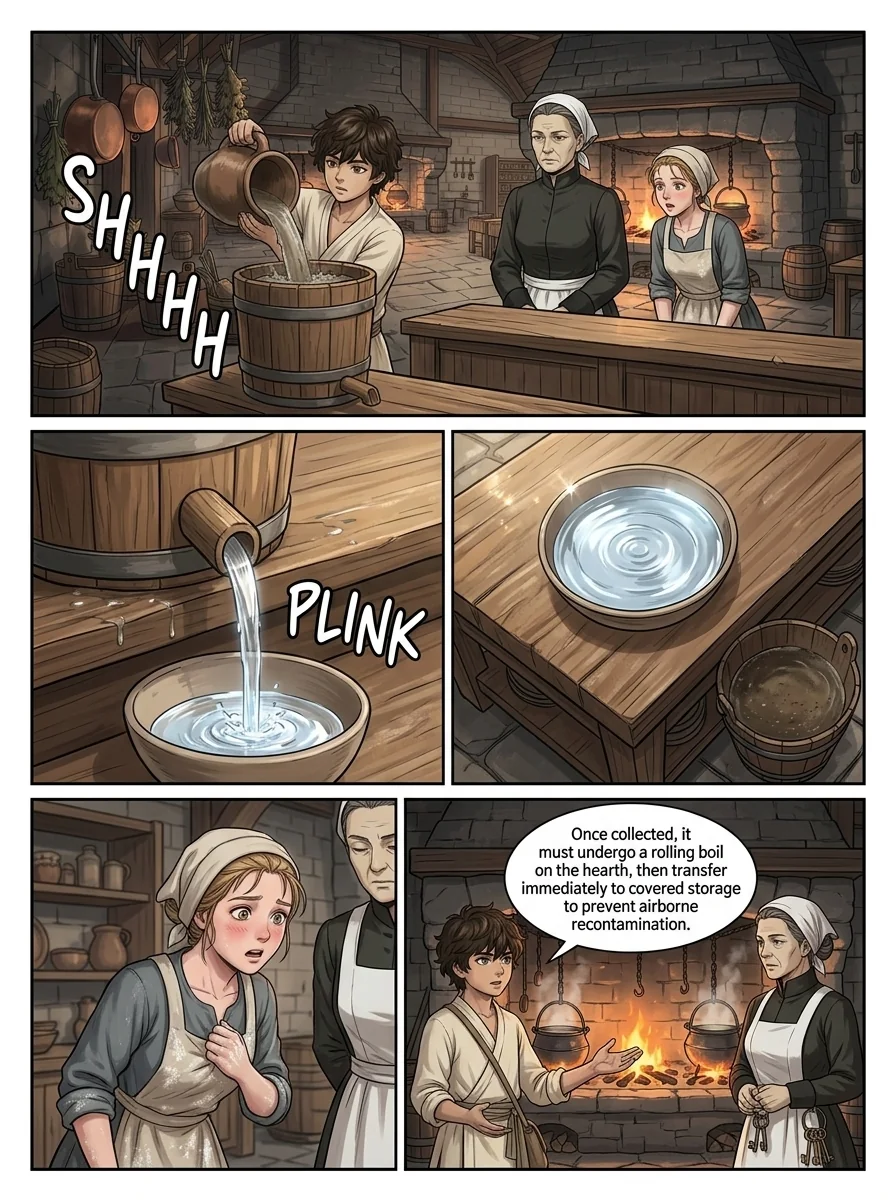
He demonstrated the improved filter.
The servants watched as the water passed through the layers and collected in the vessel below. The difference in clarity was obvious.
Then he explained the boiling process and the importance of keeping the treated water covered.
The housekeeper listened carefully.
When he finished, she asked several questions.
"How often must the materials be replaced?"
"That depends on how much water is processed and how dirty the source water is. They must be inspected regularly."
"Can a servant clean it?"
"Yes. I have written instructions and made the inside removable."
"And how much water can it process?"
The boy considered his answer.
"More than the small version, but I would prefer to observe it during ordinary kitchen use before giving you an exact figure."
The housekeeper nodded.
"Very well."
She looked at the barrel again.
"I have another question. Could you build one that is even larger?"
The boy blinked.
"Even larger?"
"The kitchen uses a considerable amount of water. We fill several pots every morning, and your device would be useful if it could process enough for the entire kitchen."
He looked at his invention.
He had spent so much time perfecting the process that he had barely considered how it would work on a larger scale.
A larger filter would need stronger supports, more filtering material, and a way to prevent the weight of the water from damaging the structure.
It would also need to be easy to clean and maintain.
And the larger quantity of water would still need proper treatment afterward.
He felt a familiar spark of excitement.
Not because he had already solved the problem.
Because someone had asked him to solve a problem that his invention had revealed.
"I believe I can," he said carefully. "But I will need to test it before I promise anything."
The head housekeeper smiled.
"Then test it. When you are ready, bring it back."
The boy left the manor with his small filter under one arm and a new challenge occupying his thoughts.
He had begun with a simple question: how could he make dirty water cleaner?
Now he understood that the real challenge was larger.
He needed a system that ordinary people could use, that could handle enough water for a household, and that would not make promises it could not keep.
For a twelve-year-old boy in Greymoor, that was a great deal of work.
Fortunately, he had never been particularly good at leaving an interesting problem alone.
**End of Chapter 4**
# Chapter 4 — A Bigger Problem · The moment he returned home from the manor, the boy began thinking about the housekeeper's request. · A larger filter. · At first, it sounded like a simple task. If a small filter could handle a bucket of water, surely a larger one could handle several buckets. · Unfortunately, making something bigger was rarely as simple as making more of the same thing. · He discovered this before he had even finished his first sketch. · His original filter consisted of a sturdy wooden frame, a container filled with layers of gravel, sand, and charcoal, and an outlet through which the filtered water could flow into a clean vessel. · It worked well enough for small quantities. · But if he increased the size of the container without changing anything else, several problems appeared. · The bottom would need to support considerably more weight. The wooden joints would have to withstand the pressure of the water. The filtering material would need to be distributed evenly, and the outlet would have to allow water to flow without carrying sand along with it. · Then there was the matter of cleaning. · A filter used by one family could be emptied and cleaned without much difficulty. A device used in a manor kitchen would be expected to work every day. · He could not build something that became useless after a few weeks. · He sat at his wooden table, rubbing his forehead. · "Why can't people simply be satisfied with the small version?" · His father, who was working on a chair near the window, looked up. · "Because the small version does not solve their problem." · The boy glanced at him. · His father returned to his work. · "And because you told them you could make a bigger one." · The boy sighed. · His father smiled faintly. · "Welcome to working for customers." · ## The Cost of Making Things · The next morning, the boy woke earlier than usual. · He ate breakfast with his parents, although his attention was clearly elsewhere. His mother noticed him staring at the wooden bowl in front of him rather than eating. · "Something troubling you?" · "Not troubling me. I'm thinking." · "Those are not always different things," his father remarked. · The boy ignored him. · "I need to build two larger filters eventually. But I don't know how much the materials will cost, or how long it will take." · His father put down his spoon. · "Then you should find out." · "I know that." · "Do you?" · The boy looked at him. · His father reached for a small wooden board and a piece of charcoal. · "Tell me what you need." · The boy began listing the materials. · "A barrel, some wood for the stand, a removable support, gravel, sand, charcoal, and something to keep the outlet from getting blocked." · "Good. What else?" · He thought for a moment. · "Tools." · "Those belong to the workshop. But if you damage one, who pays for it?" · "I do." · "Correct. What else?" · The boy frowned. · "Transport?" · "Yes." · "Time?" · His father nodded. · "Your time has value too. If you spend three days making something that earns you ten copper coins, you might have been better off helping me in the workshop." · The boy looked down at the board. · He had never properly considered that. · In his previous life, he remembered learning about production costs, wages, and profit. But those concepts had seemed distant and abstract. Here, every copper coin mattered. · His father continued. · "A merchant who forgets the cost of his own work eventually discovers that he has been working for free." · His mother chuckled. · "Your father learned that lesson the difficult way." · "That was different," his father protested. · "Of course it was." · The boy smiled. · For once, he was grateful that his parents were willing to teach him these things. They could not provide him with much money, but they could give him something that might prove just as valuable. · Experience. · After breakfast, he gathered his notes and headed toward his father's workshop. · ## The Carpenter's Advice · The workshop smelled of fresh wood and old sawdust. · His father was working on a chair for a merchant who lived near the village square. Several boards had already been cut, and the pieces were arranged neatly beside the workbench. · The boy placed his drawings on an empty section of the table. · "I need your opinion." · His father wiped his hands and examined them. · The drawings showed a large wooden container with several layers inside. Beneath it was a stand, and at the bottom was a small outlet. · His father studied the design. · "You want to build the container yourself?" · "I thought about it." · "Why?" · "Because it would fit the filter better." · "That is one reason. Is it a good reason?" · The boy hesitated. · His father tapped the drawing. · "You could spend several days making a container from separate wooden boards. You would need to make the joints tight enough to hold water, and even then there might be leaks." · He pointed toward the back of the workshop. · "Or you could buy a barrel from the cooper." · The boy followed his finger. · A barrel. · Of course. · He had been so focused on inventing something that he had forgotten he did not need to invent every part of it. · "I could modify an existing barrel." · "Exactly." · His father returned to the chair. · "An inventor does not need to make every piece himself. He needs to understand what each piece must accomplish." · The boy wrote that sentence down. · Then he looked at the drawing again. · "What about the stand?" · "That I can help you with. But you will have to pay for the wood." · "Even though I'm your son?" · His father gave him a serious look. · "Especially because you are my son. I want you to understand what it costs to make things." · The boy laughed. · "You're enjoying this." · "A little." · His father picked up a piece of wood and examined it. · "Come back this afternoon. I'll show you how to calculate the weight the stand needs to support." · That was another thing the boy appreciated about his father. · He never simply gave him an answer when he could teach him how to find one. · ## A Visit to the Cooper · The village cooper's workshop stood near the road leading toward the market. · Barrels of different sizes occupied most of the space. Some were freshly assembled, their wooden staves held together by iron hoops. Others had been repaired so many times that their surfaces were dark with age. · The cooper himself was a broad-shouldered man named Harlan. · He looked up when the boy entered. · "Well, if it isn't the young inventor." · The boy smiled politely. · "Good morning, Master Harlan." · "What brings you here? Another strange request?" · "I need a barrel." · Harlan raised an eyebrow. · "That's a surprisingly ordinary request." · "For an unusual purpose." · The cooper laughed. · "Of course it is." · The boy explained the filter and showed him his drawings. · Harlan listened carefully, occasionally interrupting with questions. · "You want water to pass through the barrel?" · "Yes." · "And you want the materials inside to remain in place?" · "Exactly." · "And how do you intend to prevent the sand from escaping through the outlet?" · The boy hesitated. · "I am still working on that." · Harlan folded his arms. · "Then you have found your first problem." · "I know." · "Good. Some people become angry when their ideas are questioned." · The cooper walked toward the back of his workshop and returned with three barrels. · The first was small and narrow, originally intended for transporting wine. · The second was wider, with a thick wooden base. · The third was an old water barrel that had been repaired several times. · The boy inspected each one. · The smallest was too narrow. The old barrel was too damaged. · The second seemed suitable. · "How much for this one?" · Harlan named a price. · The boy frowned. · "That's more than I expected." · "Then perhaps you expected too little." · The boy sighed. · "Could I buy a barrel with a small defect? It doesn't need to be pretty, only strong enough to hold water." · Harlan considered that. · After searching through his workshop, he found a barrel with a damaged outer hoop. The wood itself was still sound. · It was not particularly attractive, but it would serve. · They agreed on a lower price. · Before leaving, the boy asked whether Harlan could make a removable wooden support for the inside. · "What sort of support?" · He explained the design. · Harlan examined the drawing and nodded slowly. · "I can make that. But I'll charge you for the work." · "Of course." · "And if your invention succeeds, you'll remember where you bought your barrel." · The boy smiled. · "If it succeeds, I'll probably need another." · That earned him a proper laugh. · ## The First Large Prototype · The barrel arrived at his father's workshop two days later. · The boy had already prepared most of the other materials. · He had collected gravel from a nearby stream, washed it repeatedly, and separated it by size. The sand had been washed until the water running through it was no longer visibly muddy. The charcoal had been broken into smaller pieces and rinsed to remove loose dust. · He knew that cleanliness mattered. · There was little point in constructing a filter only to fill it with dirty materials. · His father helped him build a sturdy stand. · The boy wanted the barrel to sit high enough for the water to flow into a collection vessel beneath it. The stand also needed to remain stable when the barrel was full. · His father insisted on testing the joints before allowing him to use it. · "Better to discover a weak joint now than when someone is standing beside it," he explained. · Together, they checked the supports and reinforced one corner. · Once the stand was finished, the boy carried the barrel to his little workshop in the woods. · He placed the internal support inside and began arranging the filtering materials. · The gravel went in first, followed by the sand and prepared charcoal, with the layers arranged according to his latest design. · He worked slowly. · Each layer had to be distributed evenly. · When he finished, he stepped back and admired his work. · It looked impressive. · It was also considerably heavier than his first filter. · He placed a collection vessel underneath and poured in the first bucket of water. · Nothing happened. · He waited. · A few drops emerged from the outlet. · He waited longer. · Another few drops followed. · The boy stared at the barrel. · "You're joking." · The barrel remained silent. · He checked the outlet. It was not blocked. He examined the layers, looking for an obvious mistake. · The problem was the filtering material. He had packed too much fine sand into the barrel, and the water was passing through it painfully slowly. · His first instinct was to remove some of the sand. · Instead, he stopped and thought. · The manor did not merely need cleaner-looking water. It needed enough filtered water to make the device useful. · A filter that produced a cup every few minutes would be little better than his original small version. · He emptied the barrel and began again. · This time, he adjusted the arrangement and paid greater attention to how evenly the materials were distributed. · The second attempt flowed more freely. · Unfortunately, the water that emerged carried fine particles of sand. · The boy closed the outlet and groaned. · One problem solved. Another created. · He spent the afternoon testing different arrangements, recording how quickly water passed through and how much visible material escaped. · By evening, he had learned something important. · A filter was not simply a container filled with useful materials. · The structure holding those materials mattered just as much. · ## A Lesson from the Past · That night, the boy lay in bed thinking about the failed experiments. · He had made progress, but not enough. · His little filter had been useful for improving the appearance of water. The larger version could process more, but it still had weaknesses. · And even if he perfected the physical construction, the problem of drinking water remained. · He closed his eyes. · His thoughts drifted toward memories of his previous life. · He remembered school lessons, public information posters, and the familiar sight of water being boiled in kitchens. · He remembered something about microorganisms. · Something about temperature. · Something about how long water needed to be heated. · But the details were scattered. · He knew that boiling water could make it safer to drink, but he wanted to remember the proper method. He also remembered that water could become contaminated again after treatment if it was handled carelessly. · He turned over. · Tomorrow, he would have to think about it again. · Eventually, exhaustion overcame him. · And then he dreamed. · He was standing in a place that did not belong to Greymoor. · White walls surrounded him. Metal pipes ran along the ceiling. A large glass vessel stood on a table, and water moved through a series of containers connected by narrow tubes. · He could not read the labels. · Yet the purpose of the equipment seemed strangely familiar. · The scene changed. · He saw water being poured through a filter. Dirt and particles remained behind while clearer water flowed into another container. · Then he saw a pot being placed over a fire. · A familiar voice spoke. · "Filtering and disinfecting are not the same thing." · The boy watched the water heat. · The memory became clearer. · Boiling water was a simple and effective way to kill many disease-causing organisms. It did not matter whether the water looked dirty or clear. What mattered was that the water reached the proper temperature and was kept at a rolling boil for the recommended period. · Another image appeared. · A clean container with a lid. · A ladle resting beside it. · The voice continued. · "Clean water can become contaminated again." · The boy watched someone pour the boiled water into the covered container. · Then the scene faded. · He awoke suddenly. · For several seconds, he did not move. · The room was dark. His blanket had slipped to the floor, and the cold air made him shiver. · Then he sat upright. · "Of course." · He had been trying to make one device accomplish everything. · But the simplest solution was not necessarily a more complicated filter. · It was a reliable process. · First, remove as much dirt as possible. · Then treat the water properly. · Finally, protect it from becoming contaminated again. · He had remembered the missing piece. · Not a magical substance. · Not a miraculous filter. · Simply the knowledge that he had once taken for granted. · ## The Complete Method · The following morning, the boy was out of bed before sunrise. · He went to the kitchen and found his mother preparing breakfast. · "Mother, do we have a clean cooking pot that isn't being used?" · She looked at him. · "Good morning to you too." · "Sorry. Good morning." · She laughed. · "What do you need the pot for?" · "I want to test something." · His mother studied his expression. · "Another invention?" · "An improvement to the water filter." · She pointed toward a spare pot near the wall. · "That one is available. But don't damage it." · "I won't." · He took the pot and carried it to his workshop. · His plan was straightforward. · He would filter the water first, then boil it separately. Once it had been treated, he would allow it to cool in a clean, covered vessel. · He knew that boiling needed to be done properly. His memory suggested a rolling boil for at least one minute, with a longer period at higher elevations. Greymoor was not particularly high, but he intended to follow the safest practical guidance he remembered. · He filtered a batch of water. · Then he poured it into the cooking pot and placed it over a fire. · He watched carefully as the water heated. · When it reached a rolling boil, he maintained it for the required time. · Afterward, he removed the pot from the fire and covered it with a clean lid. · He did not drink it immediately. · Instead, he repeated the process and checked his notes. · He also began thinking about how to explain the method to someone who had never heard of invisible organisms. · He could not simply tell people that the water contained tiny creatures. · Most would probably laugh. · Instead, he would explain that water could carry sickness even when it looked clean, and that boiling was necessary to make it safer for drinking. · His mother came to inspect his work later that morning. · "So your wooden device removes the dirt," she said, "but the fire makes the water safe?" · "That is the idea." · "And if someone uses the filter but skips the boiling?" · "Then I cannot promise the water is safe." · His mother nodded. · "Good. Never promise what you cannot guarantee." · He wrote those words into his notes. · ## Testing the Routine · Over the following days, the boy worked on making the process practical. · He improved the filter so that it could produce clearer water more consistently. He also designed a separate collection vessel that could be covered after the water had been boiled and cooled. · The problem was not simply making the device work once. · It had to work every day. · He tested different quantities of water, recorded how long filtration took, and checked how often the filtering materials needed attention. · He also learned that the charcoal could become clogged and that the sand and gravel needed regular cleaning or replacement. · His first large prototype was far from perfect. · But each experiment taught him something. · One afternoon, his father found him examining the wooden support. · "What are you looking for?" · "A weakness." · His father leaned closer. · "Have you found one?" · "Not yet." · "Then perhaps you should look for one before it finds you." · The boy laughed. · His father examined the construction. · "That is a heavy barrel. Are you certain the stand can support it?" · "I tested it." · "With water?" · "Yes." · "How much?" · The boy hesitated. · His father raised an eyebrow. · "Exactly." · They tested it again, gradually increasing the weight. · One of the joints began to shift. · His father pointed at it. · "There." · The boy stared at the joint. · He had been so focused on the filter itself that he had nearly overlooked the stand. · They reinforced it together. · This time, the structure remained stable. · The boy added another note to his records. · **Test the entire invention, not only the part that seems important.** · ## The Housekeeper's Request · When he next visited his mother at the manor, he brought the improved filter with him. · The head housekeeper was waiting in the kitchen when he arrived. · "You have returned," she said. · "Yes, ma'am. I have made some improvements." · "Have you solved the problem?" · "I believe I have a reliable method now. The filter removes much of the visible dirt and improves the water's clarity. Afterward, the water must be properly boiled and stored in a clean, covered container." · The housekeeper studied him. · "So the filter alone does not make the water safe?" · "No, ma'am. I would rather tell you that now than have someone misunderstand what it can do." · For a moment, she said nothing. · Then she gave a small, approving nod. · "That is a sensible answer. A dishonest merchant would have told me his invention could do everything." · The boy resisted the urge to smile. · He was twelve, not a merchant, and he was beginning to understand that the difference between a clever invention and a trustworthy business might be honesty. · He demonstrated the improved filter. · The servants watched as the water passed through the layers and collected in the vessel below. The difference in clarity was obvious. · Then he explained the boiling process and the importance of keeping the treated water covered. · The housekeeper listened carefully. · When he finished, she asked several questions. · "How often must the materials be replaced?" · "That depends on how much water is processed and how dirty the source water is. They must be inspected regularly." · "Can a servant clean it?" · "Yes. I have written instructions and made the inside removable." · "And how much water can it process?" · The boy considered his answer. · "More than the small version, but I would prefer to observe it during ordinary kitchen use before giving you an exact figure." · The housekeeper nodded. · "Very well." · She looked at the barrel again. · "I have another question. Could you build one that is even larger?" · The boy blinked. · "Even larger?" · "The kitchen uses a considerable amount of water. We fill several pots every morning, and your device would be useful if it could process enough for the entire kitchen." · He looked at his invention. · He had spent so much time perfecting the process that he had barely considered how it would work on a larger scale. · A larger filter would need stronger supports, more filtering material, and a way to prevent the weight of the water from damaging the structure. · It would also need to be easy to clean and maintain. · And the larger quantity of water would still need proper treatment afterward. · He felt a familiar spark of excitement. · Not because he had already solved the problem. · Because someone had asked him to solve a problem that his invention had revealed. · "I believe I can," he said carefully. "But I will need to test it before I promise anything." · The head housekeeper smiled. · "Then test it. When you are ready, bring it back." · The boy left the manor with his small filter under one arm and a new challenge occupying his thoughts. · He had begun with a simple question: how could he make dirty water cleaner? · Now he understood that the real challenge was larger. · He needed a system that ordinary people could use, that could handle enough water for a household, and that would not make promises it could not keep. · For a twelve-year-old boy in Greymoor, that was a great deal of work. · Fortunately, he had never been particularly good at leaving an interesting problem alone. · **End of Chapter 4**
auto_awesome
Adapted Vertical Webtoon Panels (After)
Automatically storyboarded with persistent CharacterRef identity locking, dynamic camera angles, and manga speech balloons.
Jump to Panel 1 south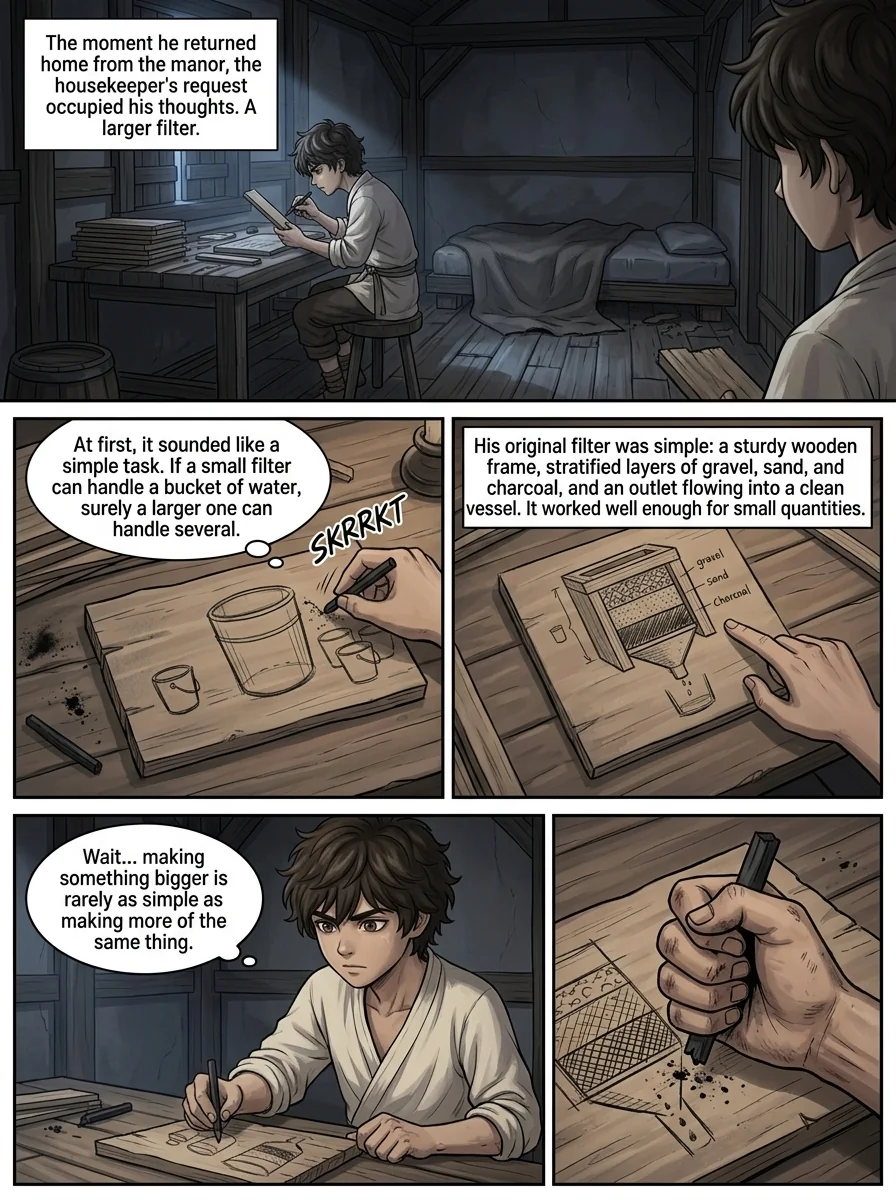
1,000 Free Starter Credits • Instant AI Creation
Inspired to Turn Your Own Story into Manga?
Paste your manuscript, script, or webnovel chapter. Render full multi-panel pages with character face consistency in 30 seconds.
Created with AI Manga Generator • Community Showcase
forum Comments & Discussion
0 commentsSign in to join the conversation and share your thoughts on this manga!
Join the discussion about characters, storyline, and AI artwork with the creator.
No comments yet
Be the first to share your thoughts on this story!